Wednesday, March 23, 2016

Best mathematics-based graphic novel I have read in at least five years!

Andriopoulos, Thodoris (2010) Who Killed Professor X?  New York:  Birkhauser.


Opening lines:  "Paris, 1900 / The City of Light is getting ready to host one of the most important conferences ever held in the history of mathematics."

Shortly after giving the opening lecture of a worldwide math conference, a famous German mathematician, called Professor X, (no relation to the X-men's mentor) falls over dead in a hotel dining room.  A police inspector is called in and, with the help of a trusted mathematician, begins to try to determine who committed the crime.  One of the difficulties, however, is that the suspects are mathematicians and have given statements that are full of math language.  So the inspector and his assistant must solve the problems to determine the location of each suspect at the moment of the murder.

As the inspector goes through each of the suspects, his assistant, Kurt, fills us in on their backgrounds.  The suspects may sound familiar to you.  We find out about Rene, Blaise, Isaac, Leonhard, Carl Friedrich, Pheidias, and Sophie,  We learn about them and their lives as we consider whether they might have been the murderer.  Working the solution provides another pice of the puzzle necessary for solving the mystery.

I'll admit, having the statements essentially be math problems is a little contrived, and not every single student will latch hold of this book, but for students anywhere from middle school to college who like a good story and a puzzle, this is a great way to connect them to geometry and algebra -- in a way that they won't even notice and will probably enjoy greatly.

I enjoyed the book a great deal.  My sixth grade daughter, who is a bit of a math wiz,did not find the book particularly engaging.  My daughter who is a high school senior (and not particularly interested in math, though she is no slouch) read the whole thing cover to cover.  I have a colleague who is a math prof who is quite excited about it, but so is his wife who is a landscape architect.  So it is hard to predict who will latch onto this book and who won't -- but since those who like it, really like it.  I suggest you buy yourself a copy as soon as you can.


Wednesday, March 16, 2016

Two Fantasy YA novels (one of which is scary) and Two Children's Lit Blogs You Should Listen To

DiTerlizzi, Tony (2010)  The Search for Wondla  New York: Simon and Schuster.


Opening Lines:"Eva Nine was dying.  The tiny scarlet dots on her hand mirrored the glowering eyes of the snake that had just bitten her.."

Eva Nine has lived her whole life in a sealed environment, cared for by a robot called Muthr.  She is in training for the day she will go outside.  Eva Nine knows there are other Sanctuaries out there somewhere and she is hoping that someday she will meet another person.  But when an invader breaks into the sanctuary, destroying the place, Eva Nine finds herself climbing a ladder, opening a hatch, and escaping into a world that is not at all what she expected.  In that world, she will find friends, enemies, and, perhaps, the answer to the questions that plague her.

This is a wonderfully written story, and a nicely illustrated one at that.  It takes the reader into another world that has enough challenges, dangers, and difficulties to have readers on the edge of their seats, and enough friends and resources that Eva Nine can meet those challenges.  It is also the kind of fully developed world that is interesting to explore along with Eva.Nine.

It is a big book (489 pages) but written at a level that a strong fourth grade readers up through high school (and college, my amazing student Megan was the one who loaned this to me) would be able to find their way into it, and though the protagonist is a girl, the story is action-packed enough that many boys might be interested in Eva Nine's adventures as well.  There are no particularly wonderful themes int he book, but neither is there anything offensive.  It is simply a fun story.  And with a couple of sequels out there, this might be just the thing to keep that voracious reader in your class busy for a while.


Choldenko, Gennifer (2011) No Passengers Beyond this Point.  New York:  Scholastic.


Opening lines:  "My mom says worry is like a leaky faucet -- every drip makes you imagine something bad on the way...trouble...trouble...trouble,,,do something...do something...do something."

If Franz Kafka wrote an adolescent novel, this might well be what it would be like (up until the ending, which is decidedly un-kafkaesque).  Finn Tomkins and hi sisters India and Mouse are flying on a plane from Thousand Oaks, California to Fort Baker Colorado.  They are flying by themselves because there mom is still working a job in California and their Uncle Red is waiting for them at Fort Baker.  Their plane, however, experiences turbulence, and when it lands, and the Tompkins kids are met by a driver, they find out they are being driven not to Fort Baker, but to Falling Bird. Falling bird at first seems like a dream town.  The kids names are on billboards welcoming them and there are crowds shouting their names.  They each get their own house with everything just as they wold like it.  Before long, however, the dream turns into a dark nightmare world where they each carry a stopwatch counting down the time they have left, and though they are trying desperately to get to Fort Baker, or back to their mom, like a Kafka novel, they find themselves trapped in waiting rooms where no one ever leaves, given the choice to sacrifice their time remaining in exchange for a job in the bureaucracy of this strange new world, and on the run from pretty much everyone who just wants them to give up trying to escape and join the hollow fulfilling life that everyone in the town of Falling Bird seems to have bought into. Unlike a Kafka novel, though, there is eventually an ending and it is actually a good one in which the character's attitudes toward themselves and each other change in good and heartening ways.  That sentence makes it sound like suddenly at the end, things get smarmy -- that isn't it.  After you have gone through the nightmare world with these characters, you share their joy in returning to their lives.

The author, Gennifer Choldenko is best known for Al Capone Does my Shirts.  This is a very different sort of book, but it is well-written.  You will want to read it before you find the student reader this is right for.  Fourth graders could handle the vocabulary, but you would need a particular kind of reader with a taste for the creepy.  This might be a good book to move addicts of the Goosebumps series into slightly higher quality writing.  There is nothing here, apart from the overall tone of the book, that anyone would find objectionable.


Two Podcasts about Children's Literature I am Recommending:

The Yarn

The Yarn offers short fascinating interviews with creators of children's literature, mostly about the craft of knitting together a book.  I have listened to excellent interviews of Gary Schmidt, Jennifer Holm, Rebecca Stead, and others.  Well worth listening to!


Galaxy of Super Adventure is not like any podcast you have ever heard before.  It is not like any podcast on this planet.  In fact, I do not recall ever encountering anything like this anywhere in the galaxy (well, maybe that one time when i was visiting the Xentarian Chaskadhel, but that was a long time ago).  Each podcast starts out with a kind of radio play about Ben, Jerzy, and Zack aboard their space ship, After a series of events involving really cool sound effects (and sometimes fear gremlins, sentient mustaches,and/or teddy grahams shortages) they eventually settle down and offer the most profoundly insightful conversations about graphic novels and how they work and why they matter and stuff like that.   If you want to learn more about how graphic novels work, this is the place.


Wednesday, March 9, 2016

Funniest YA novel about breakfast cereal mascots I have ever read!

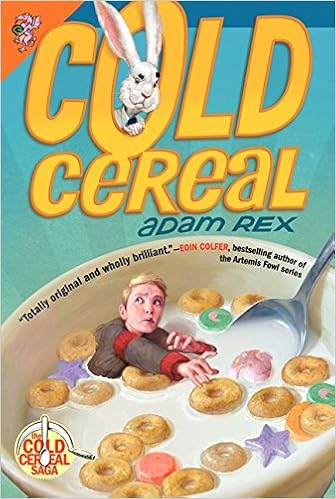
Rex, Adam (2012) Cold Cereal  New York: HarperCollins.


Opening lines:  In the busy airport, baggage turned slowly on a carousel.  A crowd of people stood around it, arms crossed and waiting, some to them staring at the silent television bolted to the ceiling.  The closed captioning at the bottom of the screen was seven seconds late and often misspelled, so though the newscasters were back and reporting on the death of billionaire Sir Peter Humphreys, the words still read: BURLAP CRISP -- ANOTHR GOOD CEREAL FROM THE GOOD FILKS AT GOODCO // THERES A LITTLE BIT OF MAGIC IN EVRY BOX.

Scott has these headaches -- and when he has them he sees weird stuff: mermaids, leprechauns, unicorns, and a talking rabbit.  Scott has always figured that is just part of what makes him different.  Then one day the talking rabbit that he is imagining steals his backpack and before long, Scott and his sister are drawn into a complicated plot involving a corrupt cereal company that is exploiting the magic in the world to not only sell more cereal, but also change the kids who are eating the cereal.  Along the way they will encounter revelations hoodlums, near escapes, plot twists, and an actual bigfoot.  

Adam Rex is the genius who wrote The True Meaning of Smekday and if you haven't read that, you should.  And if you read it and didn't think it was all that funny, then you must live a life devoid of joy or something because, boy howdy. was that a great book. (And if you saw the animated verson of it, called Home, I hope it as as good as the book but i really doubt it.

I would like to quote some of the funnier bits, but I can't because, well, it just doesn't work.  You need to be in the midst of the story for the humor to work.  And actually, besides the humor, it is a remarkably gripping book. Plus, there is both parody and satire in this book.  Good stuff.

This is best for strong middle school readers and up.  I cannot imaging anyone would object to this unless they think it is somehow arguing that unicorns and dragons really do exist. But even if it did, I cannot imagine what would be offensive about that.

Oh, and there are some nice inside jokes for theater kids too.

Wednesday, March 2, 2016

Two Good Classic Children's Books (one about rodents, the other about Jake and his grandpa)

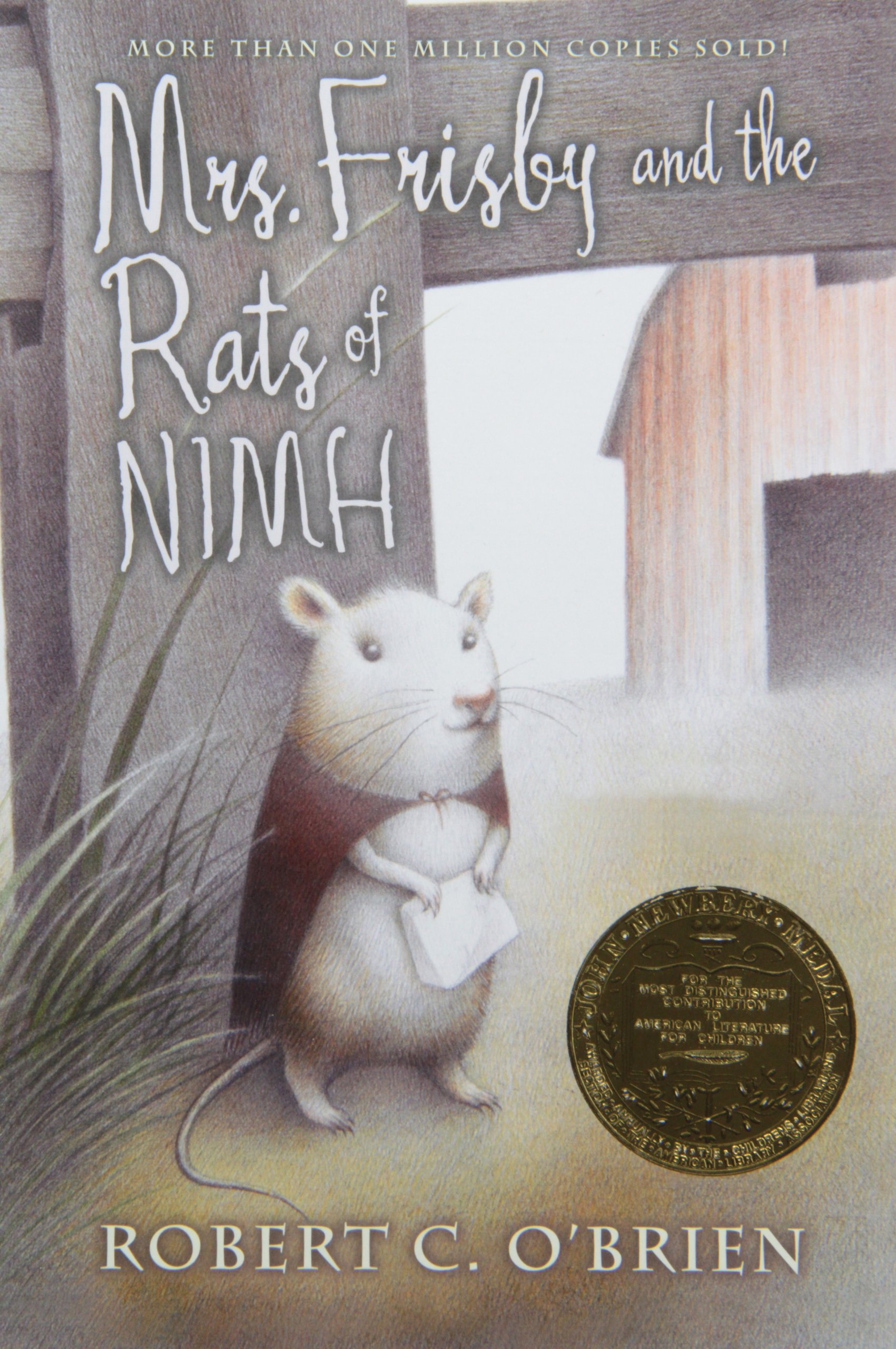
O'Brien, Robert C. (1971) Mrs. Frisby and the Rats of NIMH.  New York:  Alladin


Opening lines:  Mrs. Frisby, the head of a family of field mice, lived in an underground house in the vegetable garden of a farmer named Mr. Fitzgibbon.  It was a winter house, such as some field mice move into when food becomes too scarce, and the living too hard in the woods and pastures.

I tried to read this book once when I was younger.  I had been told it was science fiction and so when I started reading it and found that it was not, in fact, about space travel, time travel, or alien invasions, bu rather about a mother mouse trying to protect her children and a community of hyper-intelligent rats who help her, I was disillusioned and stopped reading the book.  Recently, though, after years of not reading it, I found a copy to the book read it, and found it to be quite enchanting.

Mrs. Frisby is a field mouse, whose husband was killed by the farmer's cat years ago.  As the book opens, her son Timothy is very ill, and Mrs. Frisby is determined to figure out a way to help him.   A dangerous trip to the mouse who lives in the barn and serves as the doctor, leads her to undertake a quest, first to the see an owl (an encounter also fraught with danger) and then to meet with a secret society of rats.  She finds out that her late husband was a good friend to many more creatures than she thought, and she also finds out that the rats are experimental rats form the city, that their intelligence has been greatly increased, and that they intend to found their own self-sufficient community int he mountains.  Soon Mrs.Frisby and her new-found allies are neck deep in adventure.

This is a well-told tale, makes an excellent read-aloud book, is filled with the best kind of tension, but not terror, and not likely to draw fire from event the most persnickety parent.  It is a good one.  You should read it, especially if you haven't yet.


Park, Barbara (2000) The Graduation of Jake Moon  New York:  Atheneum.


Opening Lines:  There are these three eighth-grade boys.  They've just gotten out of school for the day.  And they're about to take off in different directions when they notice something going on in the trash dumpster at the other end of the parking lot.

Jake Moon has had a harder time in middle school than most kids.  He deals with the same middle school problems that everybody else does, but he also has to deal with Skelly.  Skelly is Jake's grandpa.  Skelly has Alzheimer's Disease and has for many years.  Jake is used to having the same conversations over and over with Skelly.  Jake is used to Skelly thinking he is Skelly's childhood friend.  In fact, Jake actually likes Skelly quite a bit.  But Skelly is requiring more and more care and Jack feels like he is sacrificing his life.  Then one day Skelly wanders off and Jack's life turns upside down.

This is an amazing book that speaks to the universal feeling that happens in middle school (and high school, and maybe adulthood too) that one is being pulled in different directions.  It shows a kid who is capable of great love in spite of his hard demeanor.  It also shows that even a grandparent buried beneath layers of Alzheimer's can express a mysterious love.  This would also make a great read-aloud book.

I doubt anyone would object to this book, but if they do, tell them to talk to me.


Monday, February 29, 2016

A Graphic Novel Not About Love and a Book About Naval Battles, Both Perfect for a Very Limited High School Audience.


O'Brian, Patrick (1979) The Fortune of War  New York:  Norton.


Opening Line:  The warm monsoon blew gently from the east, wafting HMS Leopard into the bay of Pulo Batang."

When I was little, my Dad loved to take me and my two brothers sailing.  The wind and waves and the push of the wind along with time with our dad, made it usually a wonderful experience.  Even when the wind would die down and we would be stuck off shore waiting for the slightest breeze, it was a fun thing to do.  I suppose there were moments during those sailing jaunts, when I must have imagined what it would have been like to be on a three-masted navy frigate during the War of 1812, with cannon fire and smoke and what it would have been like to have been on such a ship when the entire battle could turn on how well each vessel was captained.  If i didn't imagine such a thing, I should have.

Patrick O'Brian's series featuring Captain Jack Aubrey was not written for young adults, but those that are interested in sailing, naval battles, intrigue, and occasional moments of humor, might enjoy this series.  I am sure it is best o read them in order, but I have never done so.  I buy one of the series int he bookstore every now and then.  I don't worry about where in the series I am or how far Captain Aubrey has risen in the ranks.  Instead I just settle down and enjoy the story as it takes me aboard a wooden vessel and into a wonderful world of strategy and sailing.

This particular book takes Captain Aubrey and his good friend, Naval Surgeon (and secret agent) Stephen Maturin into the war of 1812 and all the battles, politics, and intrigue that you would expect.  Frankly, though, it doesn't really matter which book you grab.  They are all quite wonderful.  This, however, would not be a good book for a new reader.  The print is small, the vocabulary advanced, and the voice takes some getting used to before you begin to recognize the funny bits.  For the right student, though, this series could keep them busy for quite a while.


Shiga, Jason (2011) Empire State:  A Love Story (Or Not)  New York:  Abrams ComicArts.


Opening Lines:  "See ya tomorrow, Jimmy. / Bye. / Hey, come with me to Longs.  I wanna grab a pack of smokes."

There is a genre of graphic novels that exists somewhere between memoir and realism, that consists of a portrayal of the everyday lives of everyday people. It tends to be sort of low energy and a little cynical and a little on the edgy side.  Empire State fits into this category.  It is the story of Jimmy, an Asian-American 20-something who works in a library and lives with his mom.  Sara, his friend, moves to New York and Jimmy decides to follow her and confess his love for her.  Unfortunately, his plans go awry and he never is quite able to tell her how he feels.  And that is pretty much how it ends.

For most of your students, this would be a depressing and perhaps pointless graphic novel to read.  It certainly will not be the most popular book in your classroom library.  But there are always some students who want a story that rings true to their experience in the world.  Punk rock, Catcher in the Rye, Who's Afraid of Virginia Woolf, black and white photography of poverty and destitution:  all these things appeal to kids who want to see their world mirrored in the art they consume.  Things don't always seem to work out.  Not every princess meets a prince.  Job offers don't always work out.  And sometimes coincidences work against us as well as for us.

The art mirrors these themes.  Shiga's main characters seem permanently slouched and pudgy.  The settings are typical and relatively uninteresting.  At one point, Jimmy goes to the observation deck at the Empire State building, hoping to meet Sara there.  Shiga draws the deck in a way that makes it seem more like a fenced in schoolyard than a place to see the city.  This is not a world of amazing vistas or unequaled metropolises, or redemptive love.  It is a world of the utterly ordinary and unremarkable.

Empire State is a graphic novels that will make that connection for that sort of student.  There is despair, banality, vulgar language, futility, mediocrity, and maybe some of the truth that student is looking for.  This is certainly not a graphic nvoel for everyone, but for some students, it might help them to know that they are not alone in how they see the world. Because of the language, it might be best to keep this one behind your desk and only loan it out to students who will be neither surprised nor offended.


Thursday, February 25, 2016

Two Graphic Novels, One of Which Absolutely Grabbed Me


O'Connor, George (2016) Apollo, the Brilliant One  New York: First Second


Opening lines:

Okay, so normally I start out any given book commercial with the opening lines of the book.  I can't do that for this book because after I read it the first time, my daughters grabbed it and read it.  Then i read it the second time and my wife asked if she could bring it to her fourth grade classroom to show let one of her students (who is crazy about George O"Connor's Olympians series) read it.  I said that would be okay as long as he got it back to me quickly and he agreed.  But then he loaned it to one of his friends to read overnight and that kid loaned it to another kid and while I am sure it will find its way back to me eventually, I don't have ti now.  But I think the opening lines must be working pretty well, at any rate.

In the other books of the Olympian's series, George O'Connor has shown that he is a master of the graphic novel format.  For example, point-of-view in graphic novels is a very tricky thing.  The first several books int he Olympians series were told in third person (though usually with an interesting focus).  When he got to Poseidon, O'Connor decided to try first person.  He had to trash several finished drafts to get it to where he wanted, but it is an excellent book.  All this is to say that Apollo: The Brilliant One may be the best yet for point of view.  Apollo's story is told by the nine muses, each one bringing a different perspective to the understanding of this multi-faceted Greek god.  Apollo, you might remember from your grade school days, is the god of everything from the sun to music and poetry and a bunch of other things.  He is also incredibly heroic and incredibly flawed.

O'Connor manages to bring all the multiple (and sometimes contradictory) stories about Apollos into a coherent narrative that is true tot he myths, but is also delightfully readable.  And O'Connor's images are clear enough and detailed enough that they give young graphic novel aficionados and neophytes alike plenty to enjoy.

Oh, and by the way, Apollo is published by First Second books, hands down the best graphic novel publisher in the business.  It is also First Second's tenth anniversary of making awesome graphic novels.  I should probably send them a card or something, because they have made my life richer with graphic novels like Zita the Space Girl, Boxers and Saints, and too many more to mention.  Maybe you should send them a card too.

The book is probably best for third grade through high school.  If you teach in one of those grade levels, buy this book.  Your best readers and your students who are still becoming your best readers will thank you.


Prince: Liz (2014) Tomboy  San Francisco: Zest Books


Opening Lines:


I wish I could be as enthusiastic about Liz Prince's Tomboy as I am about the George O'Connor book.  The idea of this book is excellent.  It is a kind of autobiographical sketch of a young tomboy and how she has trouble fitting in with boys and girls.  As this is the experience of a lot of girls who are not so girly, it obviously has a broad appeal.

The difficulty I had with this book is that the main character is hard to like much of the time.  She seems to be very self-focused (to be fair, what little kid isn't -- but somehow other books minimize this).  Since it is a kind of growing-comfortable-with-who-you-are/coming-of-age story, it makes sense that there would be some vulgar words in it, but there are a lot of them.  And Liz is saying them when she is in middle elementary school.  I know that some little kids talk like this, but that may make it hard for kids who don't talk like that to connect with Liz.  It would certainly make it hard to keep this book in a classroom library.

And then there is the fact that Liz has a (perhaps justifiable) persecution complex).  I get this too.  I am a nerd and always have been.  Middle school was rough for me until I found friends who didn't care about my nerdiness and in fact celebrated it.  Liz finds acceptance finally in the punk rock world.  But it takes a long time, and that hope in the end feels empty in some ways.

The line drawings are nicely rendered.  They are pretty sparse, but effective for the story.  It might not be a bad story for you to check out, but it would be hard to share it, in the context of your classroom, with the students who might benefit from it, without having the book challenged. I would have trouble recommending an age level for this.  It is certainly appropriate for adults, but they are perhaps the ones who need it least.


Thursday, February 18, 2016

Two good books for fourth, fifth, and sixth grade boys especially

Paulsen, Gary (1989)  The Winter Room. New York:  Dell Yearling


Opening lines:  "In the spring, everything is soft.  Wayne is my older brother by two years and so he thinks he knows more than I can ever know.  He said Miss Halverson, who teaches eighth grade, told him spring was a time of awakening, but I think she's wrong.  And Wayne is wrong too."

Everyone knows Paulsen's book Hatchet.  It is amazing, though, how many of Paulsen's other books remain on the shelves, unread.  This is a rambling set of four big interwoven stories, and within each of them, countless other stories. Here you will find the story of two boys trying to imitate their favorite western television programs by jumping from the hayloft of a barn down onto a horse and what happens next.  here you will find the story of a practical-joker elderly Norwegian farmer who, when he knew he was going to die in the deep winter, opened all the doors of his house and went into the smallest room, then lay down ont he floor with his arms and legs spread wide, knowing that his friend would find him and would have to figure out how to get his body out of the house.  And here is the larger overarching story of two boys who idolize their uncle, lose faith in his amazing powers, and then find that faith rekindled.

At 102 pages, this would make a good quick read-aloud or a good book to give to students who don't have the stamina to read a longer work yet.  Students without senses of humor, or those opposed to stories that take place in rural places should probably take a pass on this one.


Gantos, Jack (1994)  Heads or Tails:  Stories from the Sixth Grade.  New York:  Farrar Straus Giroux.


"I crept up on my diary.  Carefully I undid the lock with the small key I kept on a string around my neck, then slowly opened it.  "Ughhhh," I moaned.  The pages were filled with squished spiders."

Jack is a sixth grader with an odd life.  His dad says he has a new job and they are going to move out of the lower class neighborhood they live in with weird neighbors and alligators in the canal.  Jack keeps getting his brother into trouble.  Jack never means to, but each time it happens, his parents seem to get more frustrated with him.  Jack joins the safety patrol so he can talk to Donna, a girl he likes, but then she quits the safety patrol and he has to deal with a crabby lady whose house is next to where he walks kids across the street.  And there is a hurricane on the way.  Fortunately, Jack seems to be able to find joy or at least humor in all of his difficult circumstances..  The book is kind of dark at moments (but then, so is life as a sixth grader) but overall, seems to have a positive upswing.

Like The Winter Room, this book has an overarching story, but at the same time seems to be a collection of shorter episodes.  This might be frustrating for more experienced readers looking for a single large plot to drive the action, but for less experienced readers, the episodic stories might help them be able to take smaller bites and digest their reading as they go.

There is some mild swearing in this book (I believe the word "hell" comes up once, but nothing here that would likely cause the book to be challenged. It is a good book.