Monday, April 11, 2016

This Gary Schmidt book isn't science fiction really, but it is good!

Schmidt, Gary D. (2012) What Came From the Stars  Boston: Clarion


Opening lines:  "So the Valorim came to know that their last days were upon them.  The Reced was doomed, that the Ethelim they had loved well and guarded long would fall under the sharp trunco of the faceless O'Mondim and the traitors who led them.  The Valorim looked down from the high walls of the Reced and knew they wold find no mercy in the dark fury of the O'Mondim massed below -- none for all they had loved. "

Gary Schmidt may be the most masterful storyteller I have ever met.  Whether in writing or speaking, he weaves a spell quickly and completely over his audience.  His books are always wonderful, though sometimes it takes a while to get into some of them.  When I heard that Schmidt had written a kind of science fiction novel, I was apprehensive.  In addition to loving Gary Schmidt's work, I love science fiction (I go back to the days of Asimov, Arthur C. Clark, and Larry Niven but also love the more recent work of writers like Orson Scott Card, Neal Stephenson, Octavia Butler, and others).  And I get scared when one of my favorite writers of realistic fiction decides to give SF a try.  I think this reaction of mine goes back to when I first read CS Lewis's Space Trilogy. I had loved his Narnia books and was hoping for something similar with the Space Trilogy -- but when I read it I was deeply disappointed. Whatever Lewis was writing, it wasn't science fiction to me.  There was very little science and I had trouble figuring out who I was supposed to root for.  So when I heard about Schmidt's book, I was worried.  I didn't want to be disappointed.

The opening lines didn't sooth me either.  It seemed like he was writing a pale imitation of Tolkien.  I got really frightened.

But then I got to the end of the first chapter and the beginning of the second chapter.   It is at this point in the story that the Valorim take all the art of their civilization, all the creativity, all the beauty, and, in short, everything good and noble and honorable, and they put it into a jewel in a necklace sort of thing, and then they somehow propel it out into the galaxy and it traverses incalculable distances, enters our solar system, the Earth's atmosphere, and eventually ends up in sixth-grader Tommy Pepper's lunch box.

And then I relaxed.  Get Schmidt into our world, and I know everything will be okay.  Better than okay.  It turned out to be an excellent book. Tommy and his sister Patty who never speaks and his friend Alice are soon dealing with strange and violent happenings.  It turns out that the O'Mondim, relentless hunters from the planet that the necklace has come from, have  come to get it back.  Before long Tommy is fighting to save his house, his friends, his school, his town and maybe the planet.  Alternating chapters continue the story of the Valorim's final days which Schmidt handles well, but I found myself racing through those chapters to get back to Tommy and Alice.  There are some parts when we feel desperation for our heroes -- but there is a satisfying and beautiful ending as well.

This book would work best for good fourth grade readers and up.  It isn't really science fiction (though it isn't really not science fiction either)  And though I haven't tried it, I think it would make an excellent read-aloud book.  This one is worth getting a hold of.  You'll like it.


Friday, April 1, 2016

4 Classic Middle Grades Books (Raskin, Cooper, Sorensen, Lawson) -- two good, two pretty bad

When I am at thrift stores, I often pick up classic Newbery Award-winners just to see how children's literature has changed.  Usually I end up very thankful for the wider range of stories we have access to today as opposed to those that were available in decades past.  So join we in a quick jaunt through the decades and by the end, I think you will be glad for the Children's Literature Renaissance we are currently living in.  Let's start with the 1940s.


Lawson, Robert (1944)  Rabbit Hill New York: Dell Yearling.


Opening lines:  All the hill was boiling with excitement.  On every side there rose a continual chattering and squeaking, whispering and whistling, as the Animals discussed the good news.  Through it all could be heard again and again the words, "New Folks coming."

Apparently in 1944 the notion of a good book for children involved talking animals, many of them comical, a plot so thin it can barely be detected, and above all no significant danger, themes, or issues.  There are a few high points in the book, including the description of the joy that a young rabbit takes in just running. but there are also several awkward parts that haven't translated to the modern world very well.  Apart from the slowness with which the story gets going, there is also the moment when one of the animals refers to one of the humans as a "fat colored woman".

So even though it won a Newbery, I would pass on this one.


Sorensen, Virginia (1957) Miracles on Maple Hill.  New York: Harcourt Brace Jovanovich.


Opening Lines:  "Mother, say the scoot-thing again." Marly said.
     She slid forward in the car seat, talking right against her mother's neck, over her coat collar.  "Say it just the way your grandma said it."
     "Marly -- again?" Mother asked.  "And please don't breathe down my nexk, dear!"  She was driving, and the road was narrow and snowy and worrisome.

Perhaps prior to 1960 authors didn't believe students could  follow complicated plots or intrigue or really anything interesting.  This is not a bad book exactly, it just reads more like a narrative of a fairly interesting trip.  So Marly and her family leave the big city to visit this little house (which apparently they own) where her mother grew up.  The people there are friendly and folksy and help the family get settled in and the children learn the joys of maple surgaring time and life in the woods and stuff like that.  When their neighbor, Mr. Chris, has a heart attack, things look uncertain, but then everything is okay.  The best part of the book was that Marly's father, who had recently returned tot hem after doing time in a World War II POW camp changes from being angry and broken and self-centered into becoming a member of the community and a caring dad once more.

This one also has some dated elements that will strike the reader as odd.  Marly's brother Joe chastises her for having emotions at one point.  Later he starts to think well of her after she makes him pancakes when he is out on an adventure.  At another point one of the characters declares that the need for help in emptying maple sugaring buckets is so intense that perhaps even the girls can help carry buckets.

This might make a good read-aloud for third or fourth grade, particularly after recess.  There is not much that anyone would find offensive -- except maybe for a scene where her father burns in the wood stove the baby mice they found living in a drawer.


Raskin, Ellen (1974) Figgs and Phantoms  New York: Puffin.


Opening Lines:  The black-clad giant moved slowly, silently, like a grotesque late-afternoon chadow, past he shops on Hemlock Street.  Head erect, shaded eyes unseeing, the monstrous hovering creature seemed to defy nature as it balanced its teetering bulk on two small feet.

Although we think of the 60s as the age of psychedelia, it evidently took a while for it to filter down to children;s literature.  That is not to say that Ellen Raskin's Figgs and Phantoms  is a Kerouac-esque journey through a drug-addled mind, but it is certainly a rather odd little book  Mona is embarrassed by her family.  Her mom goes by Sister Figg-Newton and is a tap dancer and baton twirler.  Her Uncle Truman is a contortionist, Her aunt is a dog catcher.  And her Uncle Florence teams up with her to dress as a giant and scope out bookstores for good deals.  It seems that something is wrong with Uncle Florence, though.  He doesn't speak of dying, but of going off to someplace called "The Isle of Capri".  Mona wants to figure out what this heaven-like place is and how she can join him there.

Yup, that's the story.  Sounds about as complicated and confusing as Raskin's more well known Westing Game.  And it is.  It is a fascinating world to walk around in, but unlike other absurdest fictional worlds (The Hitchhiker's Guide to the Galaxy comes to mind), I found this one neither delightful nor funny.  Strong fifth or sixth grade readers might find it interesting, but I found its pseudo-spirituality and non-compelling plot didn't really grab me. I caught the many references to Pirates of Penzance but that didn't do much ofr me wither (and I doubt most of the student readers would catch those connections.


Finally we come to the 1990s and

Cooper, Susan (1999) King of Shadows  New York: Aladdin.

Image result for king of shadows

Opening lines;  Tag,  The little kids' game, plain ordinary tag, that's what they had us playing.  Even though some of us were younger than eleven, and the older ones were as big as men.


Young Nat Field loves escaping form his crummy life by doing theater.  He is excited that his summer theater group is going to be able to tour to London, but isn't looking forward to spending time with all the members of the troupe.  Some of them are bullies.  When he gets to London, Nat falls ill with what turns out to be the Plague and he finds himself transported in time back to Shakespeare's day where he ends up acting in a production of Midsummer Night's Dream and meeting Shakespeare himself.  Of course, in this new drama troupe, he finds some of the same struggles that he had in his modern troupe.  He also finds, in William Shakespeare, an adult mentor who seems to be standing in for the father that Nat has never known.

This is a well-done historical novel.  The references to Richard Burbage, and the moving of the Globe Theater and street life in London was wonderful.  It is a story that keeps the reader's interest and even has some emotional content in it.  The ending is very nicely done as well.

I highly recommend this one for fourth grade and up.  Susan Cooper is a strong writer and worth checking out.


Stay in the Boxcar Children's boxcar, a Narnian palace, Laura's cabin, or other places from children's literature!

1 April 2016

This one isn't a book review, but more of an announcement about something that sounds like aficionados of children's literature would really want to hear about.  Those of you who actually know me, know that I am not really a big Disney fan, but I got a press release from Hyperion/Disney Worldwide Publishing two days ago about  this.  So apparently based on the runaway success of Universal Studios Harry Potter-based theme park in Florida, they are "excitedly exploring the possibilities" of a children's literature based series of "Adventure Habitats"

In the press release, Hyperion/Disney spokeswoman Loo Flirpa explained that they have already negotiated the rights for many of our favorite children's books and that they are actively working on other ones.  The corporation has drawn up preliminary plans for a Boxcar Children habitat which would sleep up to six people in an actual boxcar and would include a cookfire and picnic tables for outdoor dining, a swimming hole , and a spot just upstream from the swimming hole where milk and pop can be kept cold by storing it in a "cooled grotto."

In a similar vein, families could stay in an environment based on the log cabin from Laura Ingall's Wilder's Little House in the Big Woods or actually sleep overnight on the Magic School Bus.  They are also working on designs for a room designed to look like the royal chambers at Narnia's Caer Paravel.

A Hogwarts-based dorm-style facility would include space for large groups (like family reunions) from 10 to 30.  Guests could reserve dorm spaces and common rooms in the style of any of the four Hogwarts houses.


Similar dorm-type accommodations are being planned in the style of the dormitories on board the Battle School in the Ender's Game books, those depicted in the Divergent series, and also Camp Half-Blood from the Percy Jackson series. This first phase of the project would be completed to open by summer of 2017.

Lirpa seemed even more excited about another phase of the park that she referred to as "Active Adventure Habitats".  These, she says in the press release are for guests who would like an even more realistic immersion in their favorite books (though she also cautioned that such experiences are likely to be a bit pricey -- but added that they may have a program for elementary and junior high teachers to be some of the first to try the environments -- at a reduced cost).).  For example, there will be an environment based on Gary Paulsen's popular Hatchet and its alternate reality sequels including Brian's Winter.  In this "habitat", guests would be taken to what would appear to be a campsite by a lake (with the tail of a small airplane visible sticking up from the middle of the lake) where they would have to use a hatchet to chop down enough limbs to build a lean to.  When they are finished, they can fish in the lake and cook up their catch.  .The press release hastened to add that when they returned to their lean-to, a hydraulic flap on the forest floor would have slid aside revealing already made comfortable mattresses positioned so that guests can feel like they are sleeping on the ground.  At a random time in the middle of the night, Guests can expect to be woken up by a simulated moose attack!

Another "Active Adventure Habitat" would be based on Louis Sacher's bestselling Holes.  This one would accommodate larger groups.  Guests would stay in old canvas army tents and would store their clothing in orange crates labeled "X-Ray, Zigzag, Caveman, and Barfbag."  After a wonderful night's sleep, guest would be awoken by a screaming drill sergeant and would be ushered out onto a dry lakebed where they would have to dig a hole as deep as their shovels, and would be told that if they dig up anything "interesting", they should tell the warden.

In the Lord of the Rings Active Adventure Habitat, large groups could imagine trying to sleep through the battle of Helm's Deep.  The sounds of rocks breaching the walls, the screams of those being killed by invading orcs, and finally an early morning visit from Aragorn would encourage guests to put on appropriately-sized chain mail and join the battle (though Lirpa points out the battle would be staged, and more of a photo opportunity than anything else.)

Additional Active Adventure Habitats are being planned for Hunger Games, Charlotte's Web, Animal Farm, and Lord of the Flies.  This phase of the park is slated to open in the summer of 2018.

Wednesday, March 23, 2016

Best mathematics-based graphic novel I have read in at least five years!

Andriopoulos, Thodoris (2010) Who Killed Professor X?  New York:  Birkhauser.


Opening lines:  "Paris, 1900 / The City of Light is getting ready to host one of the most important conferences ever held in the history of mathematics."

Shortly after giving the opening lecture of a worldwide math conference, a famous German mathematician, called Professor X, (no relation to the X-men's mentor) falls over dead in a hotel dining room.  A police inspector is called in and, with the help of a trusted mathematician, begins to try to determine who committed the crime.  One of the difficulties, however, is that the suspects are mathematicians and have given statements that are full of math language.  So the inspector and his assistant must solve the problems to determine the location of each suspect at the moment of the murder.

As the inspector goes through each of the suspects, his assistant, Kurt, fills us in on their backgrounds.  The suspects may sound familiar to you.  We find out about Rene, Blaise, Isaac, Leonhard, Carl Friedrich, Pheidias, and Sophie,  We learn about them and their lives as we consider whether they might have been the murderer.  Working the solution provides another pice of the puzzle necessary for solving the mystery.

I'll admit, having the statements essentially be math problems is a little contrived, and not every single student will latch hold of this book, but for students anywhere from middle school to college who like a good story and a puzzle, this is a great way to connect them to geometry and algebra -- in a way that they won't even notice and will probably enjoy greatly.

I enjoyed the book a great deal.  My sixth grade daughter, who is a bit of a math wiz,did not find the book particularly engaging.  My daughter who is a high school senior (and not particularly interested in math, though she is no slouch) read the whole thing cover to cover.  I have a colleague who is a math prof who is quite excited about it, but so is his wife who is a landscape architect.  So it is hard to predict who will latch onto this book and who won't -- but since those who like it, really like it.  I suggest you buy yourself a copy as soon as you can.


Wednesday, March 16, 2016

Two Fantasy YA novels (one of which is scary) and Two Children's Lit Blogs You Should Listen To

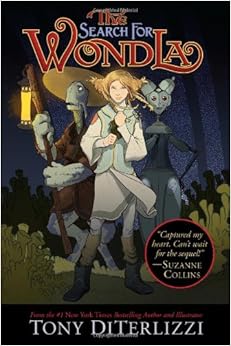
DiTerlizzi, Tony (2010)  The Search for Wondla  New York: Simon and Schuster.


Opening Lines:"Eva Nine was dying.  The tiny scarlet dots on her hand mirrored the glowering eyes of the snake that had just bitten her.."

Eva Nine has lived her whole life in a sealed environment, cared for by a robot called Muthr.  She is in training for the day she will go outside.  Eva Nine knows there are other Sanctuaries out there somewhere and she is hoping that someday she will meet another person.  But when an invader breaks into the sanctuary, destroying the place, Eva Nine finds herself climbing a ladder, opening a hatch, and escaping into a world that is not at all what she expected.  In that world, she will find friends, enemies, and, perhaps, the answer to the questions that plague her.

This is a wonderfully written story, and a nicely illustrated one at that.  It takes the reader into another world that has enough challenges, dangers, and difficulties to have readers on the edge of their seats, and enough friends and resources that Eva Nine can meet those challenges.  It is also the kind of fully developed world that is interesting to explore along with Eva.Nine.

It is a big book (489 pages) but written at a level that a strong fourth grade readers up through high school (and college, my amazing student Megan was the one who loaned this to me) would be able to find their way into it, and though the protagonist is a girl, the story is action-packed enough that many boys might be interested in Eva Nine's adventures as well.  There are no particularly wonderful themes int he book, but neither is there anything offensive.  It is simply a fun story.  And with a couple of sequels out there, this might be just the thing to keep that voracious reader in your class busy for a while.


Choldenko, Gennifer (2011) No Passengers Beyond this Point.  New York:  Scholastic.


Opening lines:  "My mom says worry is like a leaky faucet -- every drip makes you imagine something bad on the way...trouble...trouble...trouble,,,do something...do something...do something."

If Franz Kafka wrote an adolescent novel, this might well be what it would be like (up until the ending, which is decidedly un-kafkaesque).  Finn Tomkins and hi sisters India and Mouse are flying on a plane from Thousand Oaks, California to Fort Baker Colorado.  They are flying by themselves because there mom is still working a job in California and their Uncle Red is waiting for them at Fort Baker.  Their plane, however, experiences turbulence, and when it lands, and the Tompkins kids are met by a driver, they find out they are being driven not to Fort Baker, but to Falling Bird. Falling bird at first seems like a dream town.  The kids names are on billboards welcoming them and there are crowds shouting their names.  They each get their own house with everything just as they wold like it.  Before long, however, the dream turns into a dark nightmare world where they each carry a stopwatch counting down the time they have left, and though they are trying desperately to get to Fort Baker, or back to their mom, like a Kafka novel, they find themselves trapped in waiting rooms where no one ever leaves, given the choice to sacrifice their time remaining in exchange for a job in the bureaucracy of this strange new world, and on the run from pretty much everyone who just wants them to give up trying to escape and join the hollow fulfilling life that everyone in the town of Falling Bird seems to have bought into. Unlike a Kafka novel, though, there is eventually an ending and it is actually a good one in which the character's attitudes toward themselves and each other change in good and heartening ways.  That sentence makes it sound like suddenly at the end, things get smarmy -- that isn't it.  After you have gone through the nightmare world with these characters, you share their joy in returning to their lives.

The author, Gennifer Choldenko is best known for Al Capone Does my Shirts.  This is a very different sort of book, but it is well-written.  You will want to read it before you find the student reader this is right for.  Fourth graders could handle the vocabulary, but you would need a particular kind of reader with a taste for the creepy.  This might be a good book to move addicts of the Goosebumps series into slightly higher quality writing.  There is nothing here, apart from the overall tone of the book, that anyone would find objectionable.


Two Podcasts about Children's Literature I am Recommending:

The Yarn

The Yarn offers short fascinating interviews with creators of children's literature, mostly about the craft of knitting together a book.  I have listened to excellent interviews of Gary Schmidt, Jennifer Holm, Rebecca Stead, and others.  Well worth listening to!


Galaxy of Super Adventure is not like any podcast you have ever heard before.  It is not like any podcast on this planet.  In fact, I do not recall ever encountering anything like this anywhere in the galaxy (well, maybe that one time when i was visiting the Xentarian Chaskadhel, but that was a long time ago).  Each podcast starts out with a kind of radio play about Ben, Jerzy, and Zack aboard their space ship, After a series of events involving really cool sound effects (and sometimes fear gremlins, sentient mustaches,and/or teddy grahams shortages) they eventually settle down and offer the most profoundly insightful conversations about graphic novels and how they work and why they matter and stuff like that.   If you want to learn more about how graphic novels work, this is the place.


Wednesday, March 9, 2016

Funniest YA novel about breakfast cereal mascots I have ever read!

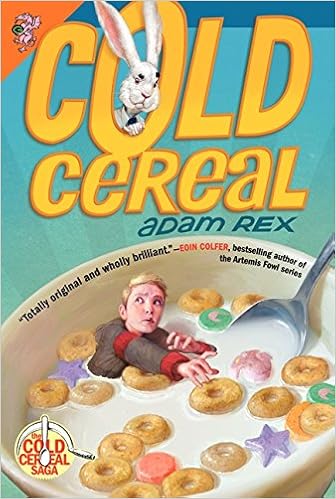
Rex, Adam (2012) Cold Cereal  New York: HarperCollins.


Opening lines:  In the busy airport, baggage turned slowly on a carousel.  A crowd of people stood around it, arms crossed and waiting, some to them staring at the silent television bolted to the ceiling.  The closed captioning at the bottom of the screen was seven seconds late and often misspelled, so though the newscasters were back and reporting on the death of billionaire Sir Peter Humphreys, the words still read: BURLAP CRISP -- ANOTHR GOOD CEREAL FROM THE GOOD FILKS AT GOODCO // THERES A LITTLE BIT OF MAGIC IN EVRY BOX.

Scott has these headaches -- and when he has them he sees weird stuff: mermaids, leprechauns, unicorns, and a talking rabbit.  Scott has always figured that is just part of what makes him different.  Then one day the talking rabbit that he is imagining steals his backpack and before long, Scott and his sister are drawn into a complicated plot involving a corrupt cereal company that is exploiting the magic in the world to not only sell more cereal, but also change the kids who are eating the cereal.  Along the way they will encounter revelations hoodlums, near escapes, plot twists, and an actual bigfoot.  

Adam Rex is the genius who wrote The True Meaning of Smekday and if you haven't read that, you should.  And if you read it and didn't think it was all that funny, then you must live a life devoid of joy or something because, boy howdy. was that a great book. (And if you saw the animated verson of it, called Home, I hope it as as good as the book but i really doubt it.

I would like to quote some of the funnier bits, but I can't because, well, it just doesn't work.  You need to be in the midst of the story for the humor to work.  And actually, besides the humor, it is a remarkably gripping book. Plus, there is both parody and satire in this book.  Good stuff.

This is best for strong middle school readers and up.  I cannot imaging anyone would object to this unless they think it is somehow arguing that unicorns and dragons really do exist. But even if it did, I cannot imagine what would be offensive about that.

Oh, and there are some nice inside jokes for theater kids too.

Wednesday, March 2, 2016

Two Good Classic Children's Books (one about rodents, the other about Jake and his grandpa)

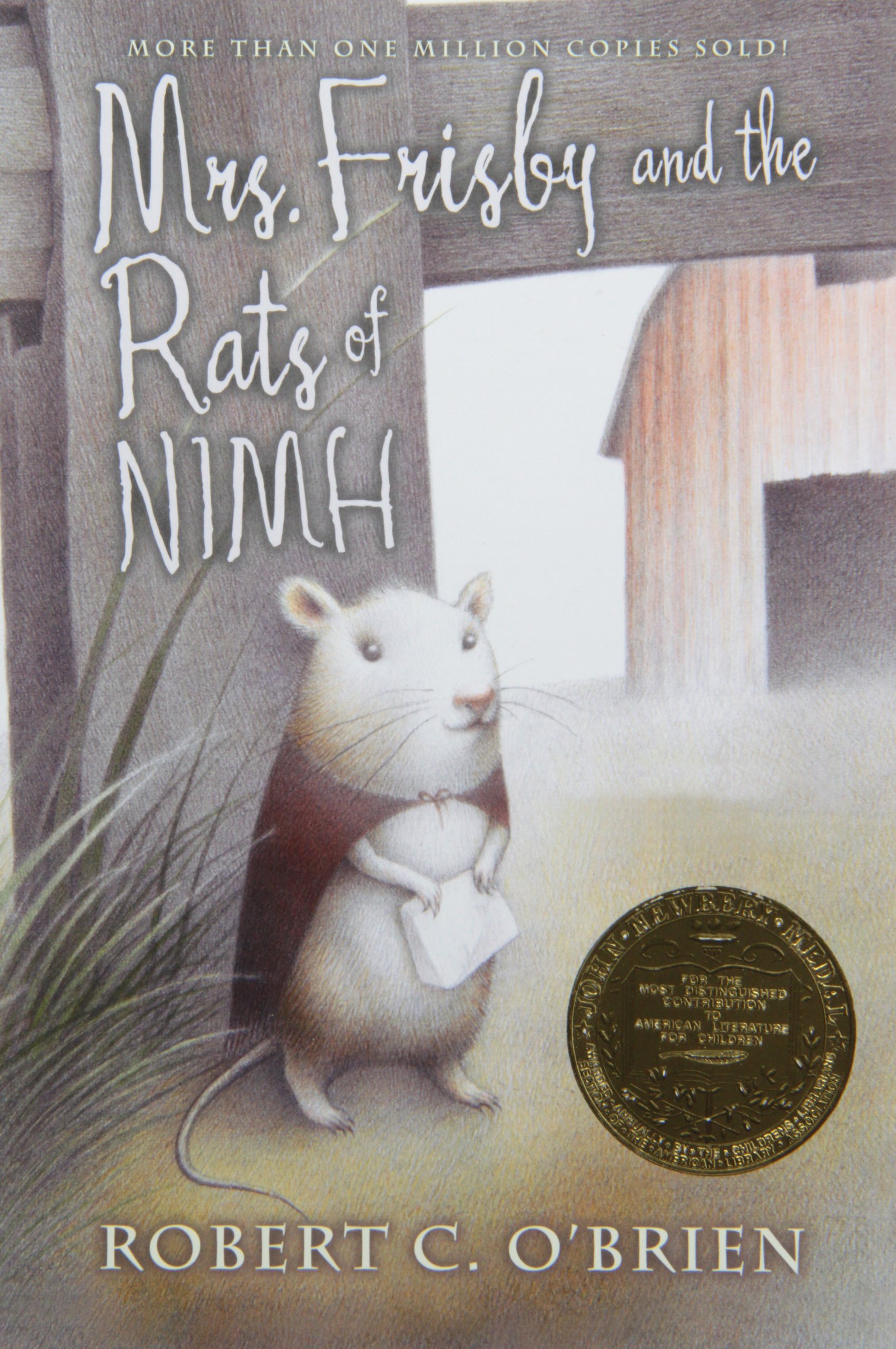
O'Brien, Robert C. (1971) Mrs. Frisby and the Rats of NIMH.  New York:  Alladin


Opening lines:  Mrs. Frisby, the head of a family of field mice, lived in an underground house in the vegetable garden of a farmer named Mr. Fitzgibbon.  It was a winter house, such as some field mice move into when food becomes too scarce, and the living too hard in the woods and pastures.

I tried to read this book once when I was younger.  I had been told it was science fiction and so when I started reading it and found that it was not, in fact, about space travel, time travel, or alien invasions, bu rather about a mother mouse trying to protect her children and a community of hyper-intelligent rats who help her, I was disillusioned and stopped reading the book.  Recently, though, after years of not reading it, I found a copy to the book read it, and found it to be quite enchanting.

Mrs. Frisby is a field mouse, whose husband was killed by the farmer's cat years ago.  As the book opens, her son Timothy is very ill, and Mrs. Frisby is determined to figure out a way to help him.   A dangerous trip to the mouse who lives in the barn and serves as the doctor, leads her to undertake a quest, first to the see an owl (an encounter also fraught with danger) and then to meet with a secret society of rats.  She finds out that her late husband was a good friend to many more creatures than she thought, and she also finds out that the rats are experimental rats form the city, that their intelligence has been greatly increased, and that they intend to found their own self-sufficient community int he mountains.  Soon Mrs.Frisby and her new-found allies are neck deep in adventure.

This is a well-told tale, makes an excellent read-aloud book, is filled with the best kind of tension, but not terror, and not likely to draw fire from event the most persnickety parent.  It is a good one.  You should read it, especially if you haven't yet.


Park, Barbara (2000) The Graduation of Jake Moon  New York:  Atheneum.


Opening Lines:  There are these three eighth-grade boys.  They've just gotten out of school for the day.  And they're about to take off in different directions when they notice something going on in the trash dumpster at the other end of the parking lot.

Jake Moon has had a harder time in middle school than most kids.  He deals with the same middle school problems that everybody else does, but he also has to deal with Skelly.  Skelly is Jake's grandpa.  Skelly has Alzheimer's Disease and has for many years.  Jake is used to having the same conversations over and over with Skelly.  Jake is used to Skelly thinking he is Skelly's childhood friend.  In fact, Jake actually likes Skelly quite a bit.  But Skelly is requiring more and more care and Jack feels like he is sacrificing his life.  Then one day Skelly wanders off and Jack's life turns upside down.

This is an amazing book that speaks to the universal feeling that happens in middle school (and high school, and maybe adulthood too) that one is being pulled in different directions.  It shows a kid who is capable of great love in spite of his hard demeanor.  It also shows that even a grandparent buried beneath layers of Alzheimer's can express a mysterious love.  This would also make a great read-aloud book.

I doubt anyone would object to this book, but if they do, tell them to talk to me.