Thursday, October 13, 2016

Second Grade Read-Aloud Recommendations.

I don't know why, but I have had two different former students email me for recommendations for good read-aloud books for second grade.  Here are some possibilities pulled from the email I sent in reply..  Feel free to comment if you have some other ideas.


Hmmm, a second grade read aloud?  Well, I know Kate DiCamillo has some wonderful books about a pig (I looked it up, -- it is called the Mercy Watson series) that are quite funny.  Let me look at my shelf and see what else I can find.  Hang on. 

Okay.  Two categories:

Classic Second grade Read Alouds:

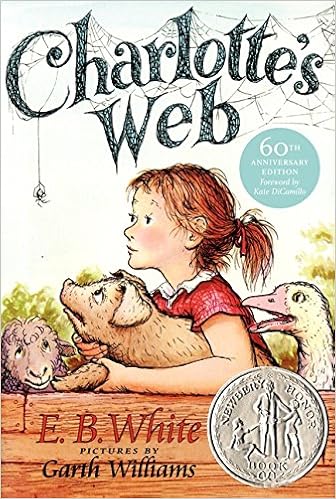
Image result for charlotte's web

Charlotte’s Web  by E.B. White
Trumpet of the Swan also by E.B. White
Flat Stanley by Jeff Brown
Horrible Harry by Suzy Kline
The Boxcar Children (the first one) by Gertrude Chandler Warner.


More recent books I think would work as second grade read alouds:

Image result for bink and gollie

Get Ready for Second Grade, Amber Brown by Paula Danziger
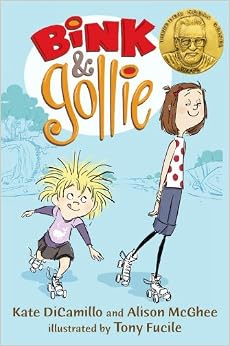
Bink and Gollie  by Kate DiCamillo  (I find this book hillarious)
Vergie Goes to School with us Boys By Elizabeth Fitzgerald Howard.  (Picture book – but worth reading to them)
Baseball Saved Us by Ken Mochizuki
The Tale of Desperaux by Kate DiCamillo  (this may be a little over their heads at the beginning of the year, but might work toward the end of second grade.)
The Cam Jansen series by Keri Arthur  (lots of fun)
Because of Win Dixie by Kate DiCamillo


Wednesday, October 12, 2016

Two YA Books With Shakespearean Echoes and One Without

So I am teaching an Honors course in Young Adult Literature and Shakespeare.  My amazing students have so far written one paper that connects Shakespeare's Tempest and the narrative arc of the Harry Potter series and another paper that connects Romeo and Juliet and John Green's The Fault in Our Stars. The next unit sets them free to think about other ways that YA literature and Shakespeare can be read side-by-side.  So I starting to read some books that have those connections explicitly or implicitly.  In that spirit, here are three YA books I have recently read that are, to greater or lesser extent, kinda Shakespearean.

Dionne, Erin (2010)  The Total Tragedy of a Girl Named Hamlet. New York: Puffin.
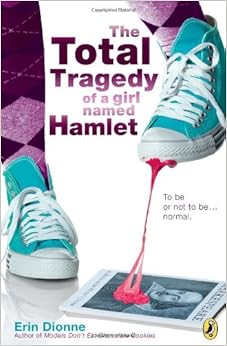
Image result for The Total Tragedy of a girl named Hamlet

Opening line:  "I hadn't figured out a way to stop time, join the circus, or make myself invisible."

Hamlet Kennedy has a difficult life.  She is in eighth grade, her name is Hamlet (courtesy of her Shakespeare-obsessed parents), her younger sister Desdemona is joining her in middle school (courtesy of the fact that she is a genius) and seems to be having an easier time getting to know the popular kids, her parents have volunteered to make a presentation about Shakespeare in her English class in full Elizabethan dress (courtesy of the fact that they are English professors), and finally, there is this boy she likes (and you can imagine how that is going).  Hamlet's other problem is her English teacher keeps nagging her to read aloud in class, which Hamlet finds embarrasing.  How can she possibly escape all these potential doom scenarios?

To tell the truth, when I first saw this book, I envisioned that it would be some version of the play Hamlet, only with a female protagonist and somehow updated to a modern school.  It isn't.  But it still would be a valuable book for those interested in Shakespeare to read. It is more about a kid who learns to appreciate Shakespeare far more deeply than she ever thought she might.  And Hamlet Kennedy does discover that she has a talent for reading out loud and acting.  This theme of discovery is a good one, especially for middle school students.

This book is suitable or middle school and early high school.  These was nothing in here that I thought would offend anyone.  It is a fun read, but there is probably not enough thematically here to justify using it as part of the curriculum.  Excellent addition to a classroom library, though.


Mandel, Emily St. John (2014) Station Eleven.  New York: Vintage.
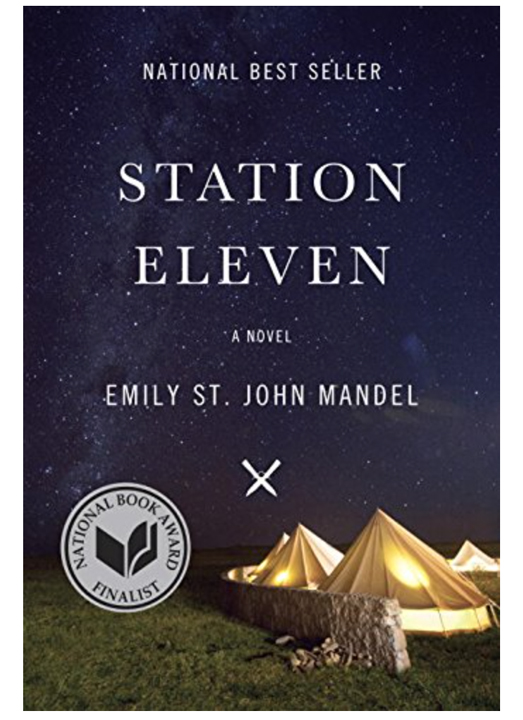
Image result for station eleven

Opening lines:  "The king stood in a pool of blue light, unmoored.  This was act 4 of King Lear, a winter night in the Elgin Theater in Toronto."

This isn't a children's book.  It isn't really a young adult novel either, but it is a book that high school students can read and will love and one that is easily paired with King Lear or other Shakespearean plays.

It starts on a stage in Toronto, where we meet Arthur Leander, a famous film actor who has returned to the stage to play King Lear.  Arthur will have a heart attack and die on stage on the same night that an outbreak of a pandemic flu will begin sweeping the globe, killing most of the humans on the planet.  A few chapters later, the book will start again, this time with Miranda who is on the South coast of Malaysia when the epidemic begins claiming lives.  Miranda is on assignment for the shipping corporation that employs her.  We also find out that in every spare moment after work, Miranda is drawing a comic book about Doctor Eleven, who lives on a damaged space station of his own design.  And two chapters after that, the book starts again, this time with Kirsten, an actor who plays with a travelling theater and orchestra many years after the plague, wandering the decaying highways of Michigan, performing for the little towns that have sprung up.  When they arrive at one such town, where Kirsten's friend and her husband had dropped out of the travelling symphony to raise a family, Kirsten finds her friend is nowhere to be found and the townspeople are strangely tight-lipped about the matter.

And from there we are swept into a story that moves forward and backward in time, slowly revealing connections between these characters and also telling the history of the world before and after the pandemic.  There are several plots in the midst of this, all of them compelling and despite the apparent disjointedness of those plots, it all come together nicely in the end.

Someone more gifted than I am can perhaps do some thinking about ways in which the plots connect to Shakespeare, but I can tell you that it manages, like the best of Shakespeare's plays, to follow a few little lives and somehow convey an epic sweep of action.  I can also tell you that Mandel is an excellent writer and not only constructs a completely believable world within the book (several actually), but also does so with beautiful attention to the sound of the words she uses.  Some chapters seem downright poetic.

As I said, this would be a good novel for high school.  There are some references to sex and one relatively minor gay character, and a bit of violence, but if this were a film, I imagine it would be PG 13.  I doubt it would be challenged.  My brother uses this one in the high school English class he teaches and says it works very well.  It would also be good for your classroom library and might work as a read-aloud.

Regardless of whether you use it or not, though, you will enjoy reading this one.  Go buy it.


Lu, Marie (2014) The Young Elites.  New York:  Putnam.

Image result for the young elites


Opening lines:  "I'm going to die tomorrow morning.  That's what the Inquisitors tell me, anyway, when they visit my cell. "

Adelina Amouteru was exposed to the blood fever when she was young.  It scarred her face and body, turned her hair silver, and also gave her mysterious powers.  After she killed her abusive but economically powerful father she attracted the attention of the Inquisition and new she is sentenced to die.  On the day of her execution, though, she is rescued by the Young Elites, a secret society of people like her dedicated to rescuing other paranormals and bringing down the oppressive rule of the king and his Inquisitors.  Adelina feels attracted to the leader of the Young Elites, Enzo, but at the same time, the leader of the Inquistors, Toren Santoro has a powerful hold over her as he has imprisoned her little sister.  Eventually, Adelina is presented with the choice of whether to use her powers to help the Young Elites or to ally herself with the Inquisiiton.

And the choice she faces might sound familiar (Anikin Skywalker, Luke Skywalker, Richard the Third, Neo from The Matrix, and so on).  It is a classic being-tempted-by-the-dark-side kind of a narrative.  Such a choice can end with the protagonist choosing the good side (Luke, Neo) or the dark side (Anikin, Richard) but what makes the story interesting is usually the struggle of their choice.  Anikin and Richard, for example, are pushed by circumstances toward a dark choice.  Anikin fights against it.  Richard embraces it, but also spends some time justifying it (as Shakespeare's villains do).  Luke and Neo are sorely tempted, but manage to stand strong.

Adelina struggles with both sides, but as I read it, doesn't so much make a decision as have it decided for her.  Perhaps this is saying something about the nature of a woman's choices in her world.  For me as a reader, though, it so eroded my ability to care about her as a character that by the end I didn't much care for her or the book.  This may have just been my take as a reader, and so you may want to check it out yourself (it is a fairly popular series).  Though I had hoped I might be able to use it in my class (to pair with Richard III,) I don't think this book would lend much to such a conversation.

This book would be best for high school.  There are some fairly passionate love scenes and one of the main characters is a bisexual courtesan.  This might cause the book to be challenged.  Frankly, though, I wasn't impressed enough to even consider fighting for it.

You are certainly welcome to read it yourself, of course, and set me straight.


Tuesday, September 13, 2016

Mighty Jack, Secret Coders, and Red's Planet: Three Excellent Graphic Novels for Middle School (including one good for math class)

Ben Hatke (2016)  Mighty Jack.  New York: First Second.

Image result for Mighty Jack


Look, just go get this one.  Right now.  Preferably from an independent bookstore in your area -- but otherwise from Amazon.  Go now.

Why havn't you gone?  What are you waiting for?  You think I am kidding? This is Ben Hatke we are talking about!  He does an excellent job with the graphic novel form, and boy, does he know how to weave a good tale.  Seriously.  And I love the way it is possible to fall right in to the world of his books, wander around for a while, have some adventures, and then come out again in time for dinner.

All right. Fine,  A plot summary?  Really?  Won't take my word for it, huh?  Okay, so there is this kid named Jack.  Summer is beginning, but since his mother has to work, his dad isn't on the scene, and his little sister, Maddy, is autistic, it is Jack's job to watch over her.  When they are at the farmer's market, a guy sells Jack some magic beans in exchange for the keys to his mother's car (the con artist will look awfully familiar to readers of Hatke's Zita the Spacegirl series).  Police recover the car eventually, but Jack's mom is angry.  Eventually Jack and his sister plant the seeds in the backyard and this crazy alien garden grows and soon both of them (and Lilly, a neighbor girl who likes swordfighting) are battling plants with tentacles, exploding plants, and something far harder to get rid of.

Well, yeah, sothe book is incomplete.  So what?  It leaves you waiting for the sequel.  That isn't a bad thing.  It gives students something to look forward to.

There. Satisfied?  Look, that plot summary doesn't begin to do it justice.  You know middle school kids who need to read this thing.  Actually, you know fourth graders who need to read this.  And maybe some high school students who are not afraid to be reading something allegedly written for younger kids.  Actually, who are we kidding,  You need to read this thing.  It is really good.

Seriously,  Graphic novels this good don't come along every day.  Go get it.

Nothing objectionable in this book -- just awesomeness.  No, listen, you can thank me later.  Just go get the book!


Yang, Gene Luen; Holmes, Mike (2015) Secret Coders.  New York:  First Second.

Image result for Secret Coders

Opening lines:  "Listen.  I'm going to tell you a story -- a story about me.  But I am telling you so you'll remember -- remember about you.
     I wasn't that thrilled about moving, but I downright dreaded Stately Academy."

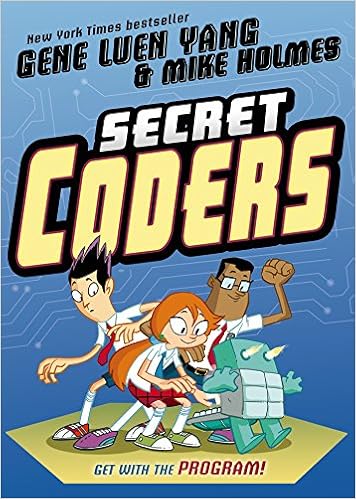
Hopper is a new girl at Stately Academy.  Though she has trouble fitting in, she is more troubled by the angry janitor who yells at her and the creepy birds that seem to be staring at her.  When she finally finds a friend, Eni, and then she finds a robot in the janitor's shed and at the same time, she also finds a mystery.  One that will require math and logic to solve.

And maybe that part scares you, because you have read other graphic novels that try to weave mathematics into a story and you fear that this one will be clunky too.  And honsetly, maybe it is a little clunky here and there, but Gene Yang is such a gifted graphic novel artist and so skilled at telling a story through words and pictures that it is unlikely you will even notice the clunkiness -- even as you are subtly being taught how binary programming language works, and how to code directions for an ambulatory robot.  This book is well worth getting for your classroom, even if you don't teach math.

I would recommmend it for fourth grade and up.  There is nothing in here that would be problematic for marents or community members that I noticed. This is a good one.  Well worth buying.


Pittman, Eddie (2016)  Red's Planet  New York:  Amulet

Image result for red's planet

Opening lines:  "Hey, here's a good one...  The Mysterious Zeke Heainey Incident by Ivan Gadunt.  Pine Mountain, Georgia -- On a cool October night, a full moon shone brightly over the tall Georgia pines.  It was one of those cold nights that stories are written about... stories told around campfires on other cold nights, under less impressive moons.  On a lonely country road, an even lonlier old pickup truck rambled along, down the lonely road of destiny.  Zeke Hainey was returning from a weekend hunting trip, his only companions:  a cuo of bad coffee, his old hunting dog, and a fading radio station.
      Aw, c'mon!  Stop the boring stuff and start reading the good parts, will ya!"


Red tries to run away from her latest foster home and is apprehended by a police officer, who puts her in the back of his prize vintage cop car.  Then that car is taken away by aliens looking for collectables and Red finds herself on a distant planet alternately excited and fascinated, scared, and having the time of her life.  She meets some rather odd friends along the way and maybe finds a home.

The art in this one is a slight characature style, funny, but real enough not to be distracting, The book is fascinatingly told and is often kind of funny.  Readers and young as fourth grade might like this one, though some of the humor will go over their heads.  I found nothing in this book likely to get it challenged or banned.  I recommend buying it for your classroom library.

Friday, August 26, 2016

Saving a school, killing a mockingbird, and a dystopian book that is more dys than topia.

Clements, Andrew (2011) Keepers of the School:  We The Children.  New York: Atheneum.

Image result for We the children andrew clements

There was a student in my Children's Literature class a couple of years ago who would raise her hand every time I asked if anyone had read a particular book.  All of my students are amazing, but this student, Nicole, seemed to have read everything.  When she told me, at the end of the year, that I had to read Andrew Clement's Keepers of the School series, I ordered it immediately.  And it came as no shock to me to learn that she was right.  It is an excellent book -- particularly for upper elementary and middle school.

Benjamin Pratt' attends a strange school.  It was built over two centuries ago by a sea captain who wanted to give the kids of the town an educational institution that would last.  The school almost seems to be as much of a boat as it is a school. with decks instead of floors and a ship's bell to signal the end of class.  When Ben starts school for the year, still reeling from his parents' separation, he finds out the school is scheduled to be torn down to make way for a huge amusement park that could revitalize the area's economy.  He also has an odd encounter with the school's head janitor, a man who has served at the school for as long as anyone can remember.  He presses into Ben's hand a golden coin, which sets in motion the story that follows (including intrigue, mischief, new friends, sailboat races, rescue, secret compartments, hidden messages, and the chance to save the school).  Almost from the star, Ben's friend Jill is a part of the story as well, but as the series develops, Jill's role expands.

Fair warning, though, the story is not complete in this book, it leads right into the next book in this series.

The book is well-written, exciting, requires student-readers to do some thinking as they go, and connects with both male and female readers.  There is nothing in the books that would cause them to be challenged, though the kids do sometimes go against school rules.  This is not a book to choose if you want to engage students in discovering new cultures -- it is very much about white, middle class people -- but it is a good story and I can think of no reason for you not to get ahold of it for your classroom library.


Acampora, Paul (2014) I Kill the Mockingbird.  New York:  Roaring Brook.

Image result for i kill the mockingbird

Opening lines:  "My mother's wheelchair does not fit through the bathroom door and
I don't know what to do about it."

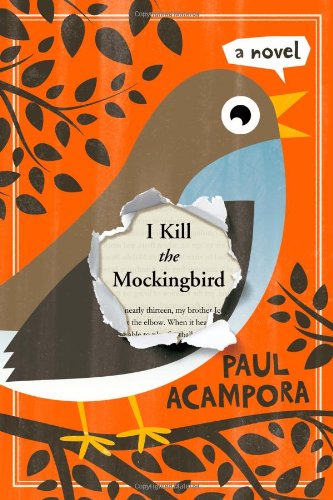
Lucy, Elena, and Michael had this amazing teacher who they called Fat Bob.  Fat Bob died at the end of the previous school year and they have been trying to figure out how to do right by him.  When they read Harper Lee's  To Kill a Mockingbird they decide that everybody should read it.  Further, they believe the best way to make people want to read it is to make it scarce and hard to find.  So they visit bookstores throughout their area and take all the copies of To Kill and Mockingbird and hide them elsewhere in the store.  Their scheme starts to pick up momentum and soon grows out of control.  But how they solve that problem is only a part of the book.  Lucy, the narrator also has to figure out how to convince her mother to eat better so she will recover from her chemotherapy, and she has to figure out what to do about her friend Elena who think is that Lucy likes their other friend Michael as more than a friend.  Especially because what Elena says might be true.  Along the way the story includes a horror Santa with an axe, major home runs, Uncle Mort's bookstore, graveyard talks, and a movement that sweeps the country.  Fat Bob would be proud.

It is a fine book.

There is some mischief in the book, but nothing that would get it challenged.  This one would be best for fifth graders and up -- but would work really well for middle school.  I can't be sure, but I think it might make a good read aloud too. And chapter 17 might make a nice little dramatic reading for somebody.

Get it.


Terrell, Heather (2013) The Relic.  New York: Soho Teen.

 Image result for the relic terrell

Opening lines:  "Eamon throws his axe into the ice above his head.  He hits a perfect depression in the wall.  Pulling up hard, he kicks the bear claw toes of his climbing boots into the wall.   He repeats this practiced motion over and over.  Like some kind of arctic cat, he scales the frozen Ring."

I was really excited about this book.  It is such a cool idea for a dystopian novel.  In the near future, after an ice age, a medieval style community sends its adolescents on a rite of passage to plumb the crevasses of a frozen sea and bring back artifacts of the previous civilization.  Especially valuable artifacts (e.g. the ones that make refrence to the false god Apple) mean that the finder will win a seat on the ruling council.  So it is both a trial and a contest.    Eva, the daughter of the chief, decides after the apparently accidental death of her brother Eamon that she is going to compete in the Testing.  Maidens are allowed to do so, but it is very rare.  The book also features an interesting love triangle, and Eva proves to be a remarkably capable competitor and anyway, as I say, when I first heard about it, I as pretty excited.

But I ended up being disappointed in the book iself, mostly because the actual writing is pretty bad in places.  Eva, whose voice the book is written in, tends to spend most of her time thinking about her motivation to do something and asking questions about why she should or shouldn't do it.  I can imagine books in which such an approach would lead me to be very interested in the main character and share in that character's difficulty in making certain decisions -- but this book is supposed to be, to some extent, an action book.  In the moments when things get really exciting -- when Eva is scaling an ice wall or dogsled racing against the other competitors or helping a competitor in clear violation of the rules -- she begins this lengthy and tiresome internal monologue.  It made me want to scream at the book sometimes.

Maybe you like that sort of thing -- maybe it just isn't my kind of book.  If so, you might want to pick it up and read a chapter or two and see what you think.  There is nothing particularly offensive here -- though I suspect some readers could see parts of the book as an indictment against religion -- and I doubt it would be challenged.   I'll leave the choice to read it up to you, though.

Tuesday, August 16, 2016

Three Classic Adolescent Novels about violins, horses, and a kid named Hubbo.

Classic novels are interesting.  Sometimes even though a book might be forty or fifty or a hundred years old, the storytelling is so spellbinding that the dated references and anachronisms fade so far into the background that you don't even notice them.  Other times it becomes clear that tthe way we view the world has changed so much that even a good story can get bogged down my moments of cultural disconnection for the modern reader.  Here are three adolescent novels I read this summer.  Some of them would be excellent for a contemporary classroom.  Others might be more of a stretch.

Wolff, Virginia Euwer (1991) The Mozart Season.  New York: Scholastic.


Opening lines:  "In Mr. Kaplan's studio is a needlepoint pillow, on a chair.  On one side of it is a violin.  The other side says, 'A teacher is someone who makes you believe you can do it.'"

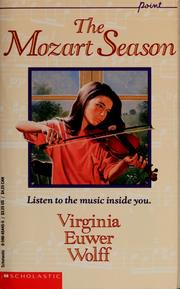
Allegra Shapiro is going into eighth grade.  She loves playing the violin and is pretty good at it.  Toward the beginning of the summer, just after her softball team fails to make the playoffs, she finds out that on the strength of her audition tape, she has been accepted into the prestigious Oregon Bloch Competition.  She will compete at the end of the summer, if she decides to go for it.  Over a summer that includes subbing for an injured violinist at a community orchestra concert, a visit from her rather odd aunt, family mysteries, and a quest to find the tune that a dancing homeless man has been looking for for decades, Allegra practices and focuses, and finally makes a decision.

This is not an action book, but it doesn't move slowly either.  Allegra's first person narrative voice, her interesting life, and a plot with some twists and turns will keep students interested.  Obviously, this will be an easy book to convince violin-playing students to read, but I think it might be worth suggesting that thoughtful non-musicians give it a shot as well.  i would recommend it for strong fourth-grade readers and up.

There is nothing in this book that I noticed that would be offensive to parents or cause it to be challenged.  I would probably work as a decent read-aloud, though it doesn't strike me as one that would grab all the students. This would be a great book for your classroom library, though.


Doyle, Brian (1988) Easy Avenue.  Toronto:  Groundwood.


Opening lines:  "My last name is O'Driscoll and my first name is Hulbert.  When I was little I couldn't say the word Hulbert very well.  The word Hulbert came out something like Hubbo and everybody started calling me that.  They still call me that.  Hubbo.  Hubbo O'Driscoll."

One of the reasons to read classic adolescent literature is to get a sense for how much it has changed over the last three or four decades.  Easy Avenue is a funny and interesting book, but it isn't in any kind of a hurry to get to the plot of the book.  When  I was six chapters in, I almost gave up on it.  There was no real plot development at that point and I wasn't sure I even liked the main character, Hubbo yet, and the period wasn't always described in a way kids can relate to.  Also, in the first half of the book, there are cruel pranks that go unpunished.  In fact, I am not sure why I kept reading.

But I did.  And here is the thing.  At the end of this book Hubbo shows himself to be a truly Nobel young man in a way that is very uplifting, and believe it or not, made the first half of the book worthwhile.

I am not sure what kind of kid would like this book.  It is short (only 118 pages) and so it might make a good read aloud if you can hold students attention for the first half.  There is a girl in the story whose reputation is unfairly damaged.  The language is not explicit, but I suppose could cause very sensitive parents to object (though I would find that highly unlikely).  The vocabulary is at a level that a fifth-grader could understand it, but it might be better for middle school (especially for the kid who always picks the shortest book).  I wouldn't call this one a must-have, but if you stumble across it, it would not be a bad addition to your classroom library.


Seredy, Kate (1935) The Good Master.  New York:  Scholastic.


Opening Lines;  "Jancsi was up bright and early that morning and at work milking the cows.  He was so excited that he couldn't stay in bed.  For today Cousin Kate was coming."

One of the things books should do is give readers a good into other cultures, times, and worlds.  This book brings the reader into Hungary around the turn of the 20th century.  The question, however, is what we do with a culture that has values that may be at odds with the values of 21st century America.  On the one hand, this is a heartwarming story about a rather difficult city girl  who is sent by her parents to live with her Uncle and Aunt and cousin and through kindness and strictness, learns to behave correctly and becomes a delightful person to be around (and along the way we learn about Hungarian Easter Egg art and some other cultural details).  On the other hand, it is a story that describes corporal punishment as being a good thing, moves from breaking gender stereotypes to reinforcing them, and is particularly harsh in generalizing "gypsy" children as "swarms of dirty little wretches..." who "...steal like magpies."  There are some parallels between this book and Shakespeare's Taming of the Shrew particularly in the way that Kate is tamed.  There are some negative depictions of the city as an exclusively unhealthy place.  There are also truly wonderful moments, such as when Kate is reunited with her dad. So this book is kind of all over the place.

I would have a hard time imagining this book being used in a straightforward way in a classroom, but I could see it as an excellent subject of a critical response by fifth graders and up.  If it is used in that way, it would be less likely to be objected to by parents.  Read it yourself and see what you think.

Monday, August 1, 2016

Three Excellent Graphic Novels -- with three amazing female protagonists

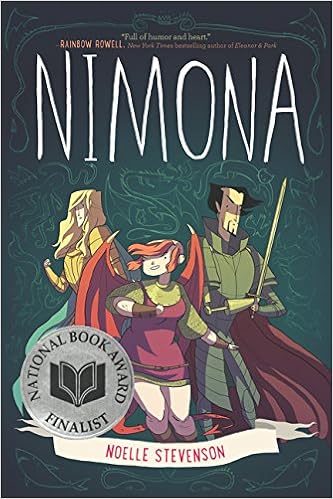
Stevenson, Noelle (2015) Nimona.  New York:HarperCollins.


Opening lines;  Lord Ballister Blackheart:  "What?  Who are you?  How did you get in here?"
Nimona:  "Hey, Boss!  The name's Nimona."
Clanking sound as he extends his metal arm.
Nimona:  "Oh. huh.  The agency sent me.  I'm your new sidekick."
Lord Balckheart:  "That makes no sense.  Why would they send some kid to be my sidekick?"

Thus begins the story of Nimona and Lord Blackheart.  Nimona thinks of Blackheart as the most accomplished villain ever and wants to learn to be just like him.  She is disappointed when she finds out that Lord Blackheart has rules -- he doesn't kill people indiscriminately, least of all his arch nemesis, Sir Goldenloin.  When, with Nimona's help, Blackheart discovers corruption in the kingdom, he needs to seek out his hated enemy Goldenloin to help.  And somewhere along the way Nimona realizes that Blackheart is close to uncovering her secret, that she is not just a shapeshifting kid sidekick, but far more.

Stevenson draws here characters right on the edge of cartoony and realistic and is remarkably good with using the panel divisions to tell the story in a way that is funny and gripping at the same time.

This is a fun and funny story that would be great for middle school and older readers who have read some comic books or fantasy (doing so will help them to get more of the jokes.)  It is remarkable story about loyalty, friendship, and, strangely (for a book with the villain as the main character) about doing the right thing.

There is nothing particularly controversial about this book.  Though in the interest of thoroughness, I should mention that some adult readers might wonder if the book is implying a relationship that is more than friendship between Blackheart and Goldenloin, but any such implications are speculative at best (and no student-reader shy of high school is likely to consider them. )  Bottom line, it is a wonderful book.  Buy it.


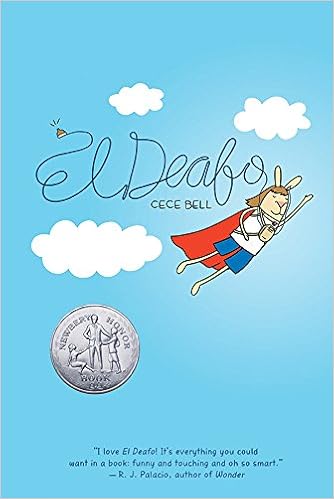
Bell, Cece (2014) El Deafo.  New York: Abrams.


Opening Lines:  "I was a regular little kid.  I played with my mom's stuff.  I watched tv with my big brother, Ashley and my big sister, Sarah.  I rode on the back of my father's bicycle.  I found caterpillars with my friend Emma.  And I sang."

On page 2, however, Cece gets very sick.  She is rushed to the hospital where she is diagnosed with Spinal Meningitis.  Eight pages later, she is out of the hospital but eventually realizes that she is deaf.

And what happens next is amazing.  the best books in the world let you get inside the mind, body, emotions, and life of another person.  Bell's drawings and writing take you inside Cece's life.  You see her triumphs and loses and struggles to fit in while wearing a clunky hearing aid around her neck.  Bell draws all her characters as rabbits.  While I have no idea why she chooses to do this, I can tell you that it works.

The bottom line is that this is a story of a little kid trying to fit in and having a hard time of it.  So yea, it is valuable as a way to live inside the shoes of a deaf person for a while, but it might be even more important as a story about how schoolmates can be jerks, but also how eventually things get better.

Fourth graders and up would enjoy this one.  Cece discovers at one point in the story that she can listen in when her teacher leaves the room but forgets to take off the mic that hangs around her neck, and as a result, Cece becomes invaluable to the class as a lookout when they are engaging in mischief of one sort or another.  I suppose some parents might object to the rule-breaking but it serves to make a point about the difficulties of fitting in socially with a difference when you are in late elementary school.  Buy this one too.


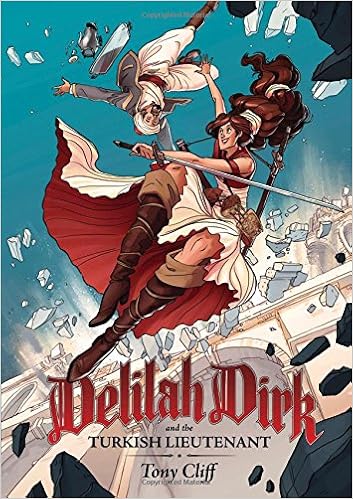
Cliff, Tony ((2013) Delilah Dirk and the Turkish Lieutenant.  New York: First Second.


Opening lines:  Constantinople (Istanbul) 1807.
 Lieutenant Erdemoglu Selim:  "Tell ne friend, who is this?"
Cafe Owner:  Hm?  Ah.  Halukoglu Bahadir.  Freshly returned from Siam I hear."
Selim:  "Mm, yes.  He's been telling stories of it."
Owner:  "Sound's very exotic."
Selim:  "Very."

Selim leads an uneventful life working in the court as part of the Janissary Corps.  He likes cafes, hates fighting, loves a good cup of tea, and avoids stress at all costs.  Unfortunately, he is sent to interrogate a recently caught thief who seems to be a combination of Indiana Jones, Wonder Woman, and maybe that sword-wielding elf who unaccountably appeared in the second Hobbit movie.  She loves the tea he brews for her and tells him her whole story.  As Selim is reporting to his superiors, Delilah Dirk escapes and soon Selim finds himself branded a traitor and, along with Delilah, on the run from his own fellow troops.

And there begins a romp through the middle east that is the sort of non-top action and wisecracks that would make Indiana Jones proud.  The illustrations are reminiscent of the best comic books -- they move the action along and make the story magically bombastic.

This one is good for fourth grade and up as well.  There is a bit of violence, but really more property damage than lives lost.  This, too, is one you need for your classroom library.


Friday, July 22, 2016

Weapons of Math Destruction, Kid versus Captain, and the Incarnation of War looks for Love

I got lost in some excellent science fiction and fantasy novels the last couple of week.  I have got some excellent graphic novels on deck, but first, some good old fashioned SF/F stuff.

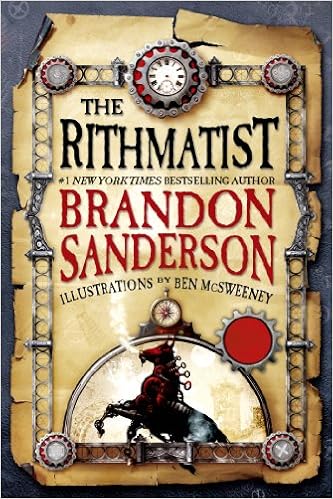
Sanderson, Brandon (2013) The Rithmatist  New York: Tom Doherty.


Opening lines:  Lilly's lamp blew out as she bolted down the hallway.  She threw the lamp aside, smashing oil across the painted wall and fine rug.  The liquid glistened in the moonlight.
      The house was empty.  Silent, save for her panicked breathing.  She had given up on screaming.  Nobody seemed to hear.

This book is by far the best book I have read so far this year.  The story takes place on a world very similar to ours, only the United States is a grouping of islands and the main focus of society is fighting the wild chalklings who are ravenously destructive neasts that are confined to the isle of Nebrask.  The human army keeping them at bay are Rithmatists, who can use a kind of geometry-based magic (yes, you read that right) to keep the chalklings under control.  Joel is a remarkably smart boy who does poorly at school and is really interested in the Rithmatists, even though he is not one.  When he gets a position working as the assistant to a kindly Rithmatist professor for the summer, Joel meets Melody, herself a failing Rithmatist and soon all three of them become involved in a murder mystery with serious implications for the continued survival of humans.

This book keeps you guessing about who the bad guy is (and the ending is satisfying in that you might be able to guess part of it, but by and large, you won't see it coming)  Joel is an excellent protagonist as is Melody, once you get to know her.  And it turns out that geometry is actually pretty fascinating when it is a matter of life and death.  This is a book where there are clear divisions (and some fuzzy ones too) between the forces of good and evil and you will find yourself rooting hard for the good guys.  It has a hint that something romantic might develop between Joel and Melody -- just enough to be intriguing but not to distract from the story.

I know some smart fourth and fifth grade readers who would enjoy this, but it is really ideal for sixth grade and up.  And for math teachers looking to build up their classroom library -- run to your local independent bookstore and buy it today.  Your students will love it (but you will love it even more).  In fact, you might consider using it as a read aloud.  There is nothing particularly offensive int he book, though it is scar in some portions and occasionally the violence is pretty graphic.  Nothing compared to prime time television, though.

Get it.  Read it. Have your students read it.  Good stuff.


Card, Orson Scott (2008) Ender in Exile.  New York: Tor.


Opening Lines:
Dear John Paul and Theresa Wiggin,
You understand that during the most recent attempt by the Warsaw Pact to take over the International Fleet, our sole concern at EducAdmin was the safety of the children.  Now we are finally able to begin working out the logistics of sending the children home.
      We assure you that Andrew will be provided with continuous surveillance and an active bodyguard throughout his transfer from the IF to American governmental control.

I am assuming you have read Orson Scott Card's Ender's Game.  You haven't?  Seriously?  Look, there is no sense even talking about Ender in Exile until you have read Ender's Game.  Go read it now.  I'll wait.

Okay.  You read it?  Good.  It is an amazing book isn't it.  I remember reading it when it first came out.  There were a lot of people ravenously waiting for the next book in the series to come out.  Before long, Card released Xenocide and Speaker for the Dead and they were good -- but they didn't have the same kind of gripping story that Ender' Game did.  Then, in 2008 (apparently -- I just discovered it last month in an awesome independent bookstore in Moab, Utah) Card came out with Ender in Exile.  I'll tell you what -- Ender in Exile is a much better sequel than the Speaker for the Dead or Xenocide.  Ender in Exile takes place just after the triumphant end of the Formic War.  The nations of earth are starting to fight over who will control the genius children who helped win the war.  Ender and his sister Valentine make the decision to leave in a ship that is carrying colonists to inhabit one of the dead Formic worlds.  The journey will take two years on board the ship, but while they are travelling, forty years will pass on Earth.  When they arrive, Ender is to serve as governor.  Unfortunately, the captain of the starship they are on has his own designs on that position.  How can Ender, a twelve year old boy, possibly outwit the man who has all the control (and also avoid an assassin who awaits him at the colony and negotiate his first romantic relationship.)

This book isn't' as good as the Rithmatist, and  it isn;t as good as Ender's Game -- but that still leaves plenty of room for it to be honking good.  This book is perhaps best for anyone who has already read and loved Ender's Game.  Nothing particularly objectionable here besides a couple of very occasional  vulgar words.  Too long for a read aloud, but excellent for a sixth grade and up classroom library.


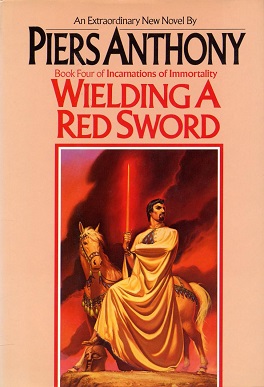
Anthony, Piers (1986) Wielding a Red Sword.  New York: Del Rey.


Opening lines:  It was a travelling show, the kid that drifted from village to village, performing for thrown rupees.  There was a chained dragon who would snort smoke and sometimes fire when its keeper signaled.

When I was in high school I think I read very book Piers Anthony had written.  I started with the gripping and hilarious Xanth series, then read several other books before I discovered his incarnations of immortality series.  I devoured those too.  But somehow the whole lot of them got lost in a move somewhere and it wasn't until I recently encountered this book in a bookstore that I remembered how much I liked it and re-read it thinking about its appropriateness for the classroom.

And that is where things get difficult.  It is an interesting book.  Mym, the main character is a prince who runs away.  He falls in love with a circus performer, but then ends up agreeing to take the mantle of the incarnation of War.  Soon he has a pale horse that can move astonishingly fast and a red sword that can stop time.  However, he finds it difficult to maintain relationships.  He also finds out that the incarnation of Evil is trying to manipulate him.

It is an interesting and fun premise and makes for a good fantasy novel, but i had forgotten the enthusiasm with which Piers Anthony descries the physical nature of War's interaction with several women who he becomes involved in.  I don't remember that affecting me much as a high school kid, and there are some interesting themes that work themselves out as War tries to figure out how physical attractiveness, intellectual interaction, and deep caring are parts of what makes love work.  The female characters in the book tend to be pretty passive and certainly couldn't stand up to Katniss, Triss, or Hermione Granger.  In fact is was somewhat startling to me to remember that just a few short decades ago there was a clearer divide between boy books and girl books.

I am not sure this one is suited for a high school classroom.  It is a good story, but perhaps best left for readers to discover on thier own.