Wednesday, January 20, 2016

Book with knights, swords, and ghosts! (just sayin')

Funke, Cornelia (2012)  Ghost Knight.  New York:  Little Brown


Opening lines:  "I was eleven when my mother sent me to boarding school in Salisbury.  Yes, granted, she did have tears in her eyes when she brought me to the station.  But she still put me on that train."

Jon hates boarding school at first, but then he discovers a friend in the form of a quirky girl named Ella.  Then, together, they discover some ghosts.  One ghost says he is there to protect Jon from the other ghost, who he says is a murderer.  Jon, however, isn't sure who to trust.  This is a king of mystery/adventure story.  The more Jon and Ella learn about the two ghost's histories, the closer they see to get to danger.

To be honest, I don't think this book is as good as Funke's Inkheart series, or the less well-known Igraine the Brave.  I thought the story was sometimes disjointed and I had trouble entering into the world of this book.   But I am not sure my opinion matters.  This is a book that has knights, swords, and ghosts in it.  That alone should be enough to attract the attention of many elementary and middle school readers.  I don't think it will end up being thier favorite book, but this one will keep their attention for a while.

This book is accessible for strong third grade readers through middle school.  Although Jon talks back to his step-father a bit and although the book has some violence in it, I cannot imagine that there is anything in here that any reasonable parent would object to.

So if you know of a student who is crazy for knights and swords, this might be worth passing on to them.  But this isn't the book to try to ignite a new interest in knights and their world.

Monday, January 18, 2016

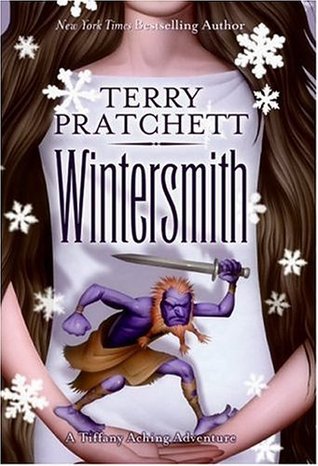
Small blue protectors, a lovesick embodiment of winter, a plucky heroine -- it all adds up to a honking good novel!

Pratchett, Terry (2006) Wintersmith  New York:  Harpercollins


Opening lines:  When the storm came, it hit the hills like a hammer.  No sky should hold as much snow as this, and because no sky could, the snow feel, fell in a wall of white.

The things that made me the most sad when Terry Pratchett died last year at the age of 67 is that he won't write any more Tiffany Aching adventures.  I met Tiffany in the pages of The Wee Free Men which my friend Kris loaned to me.  In that book, Tiffany, a poor girl living in the chalk hills, takes up the mantle of her grandmother, becomes a witch, and protects her impoverished village from an ancient evil.  She does so aided by the Feegles, an army of wee blue Irish guys whose loyalty and thick heads help her out of a scrape more than once.

In Wintersmith, Tiffany stumbles into what she thinks is some kind of joyous celebration in the woods, but is actually the magical dance between the embodiment of Summer and the embodiment of winter,  Tiffany finds the music so infectious that she joins in the dance and accidentally takes the position of Summer.  Next thing she knows, she is dancing with the Wintersmith, and when the dance is over and she returns to her normal life, she finds that the Wintersmith is in love with her and that this is going to cause some huge snow-covered problems in her life.

The plot is a good one, but what makes the book wonderful is the combination of Pratchett's writing style and sense of humor. He is not afraid to let his characters wander into tangents for a while if they are funny and wonderful.  For example, on page 179, well into the story, when things are getting desperate indeed, we come upon this passage, "Deep in the snow, in the middle of a windswept moorland, a small band of travelling librarian sat around their cooling stove and wondered what to burn next... The librarians were mysterious.  It was said that they could tell what book you needed just by looking at you, and they could take your voice away with a word."  It turns out that they have burnt all of their furniture and much of their wagon, but will not consider burning the books.

Or later, when Tiffany's mentor dies and she is trying to clear the cottage before the funeral, she is visited by Anoia, Goddess of Things that Get Stuck in Drawers.  There are moments like this scattered through the book.  It is the sort of book that tempts you to read parts of it aloud to your friends and family, though, of course, since they haven't read the book, it doesn't seem nearly as funny to them as it actually is.

So anyway, it is a delightfully funny and gripping book and I loved it.  I cannot say for sure if you will, but I think it not unlikely.  It would be best for strong middle school readers, or better still for high school readers.  There is nothing particularly offensive about the book except that it does talk about witches (though in this book, they seem to be more village wise women and healers than they do evil, twisted servants of darkness -- but readers who do not wish to read about witches good or bad should probably avoid this one.


Thursday, January 14, 2016

Three Graphic Novels (Two of which would be great for a high school history class)

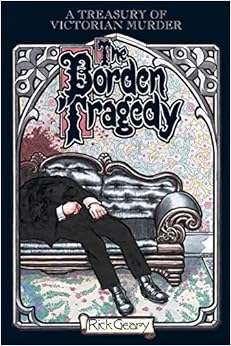
Geary, Rick (1997) The Borden Tragedy.  New York: Nantier, Beall, and Minoustchine.


Opening lines:  "The grim and seething summer of 1892 will never depart my memory... Nor, I daresay, will it be ever forgot by the good citizens of Fall River."

My knowledge of the Lizzy Borden tragedy, admittedly, did not extend beyond the sing-song nursery rhyme that begins “Lizzy Borden took an axe…”  In fact, however, the case was considerably more complicated than the rhyme makes it out to be.  In the summer of 1892, in the small town of Fall River, Massachusetts, Andrew and Abby Borden were murdered in their own home apparently by repeated blows from a hatchet.  In this nicely presented graphic novel, Rick Geary draws primarily from an account of the time that came to light in a 1990 estate sale, though he confirms the facts with a comprehensive bibliography.  Geary uses the voice of the anonymous account to guide the narrative, and uses his detailed line drawings to provide details about the layout of the house and the relative reported locations of the suspects. He also includes reprints of the articles from that time period in the back of the book (which would be interesting for students to read due to the amount of editorializing and moralizing in journalism at that time
            The upshot is, this is a well done graphic novel that will be of high interest to many readers, but also could be useful in a history class for the attention that Geary gives to the importance of sourcing and corroborating his sources.  He also provides contest to the Victorian time period in which the murder occurred through illustrations of the architecture, fashion and sensibilities of the time. 

            Though a double murder of a married couple is itself rather horrific, Geary doesn’t play up the gore.  Illustrations of the discovery of the bodies are handled sensitively.  The result is a graphic novel that will grab the attention of students while at the same time being unlikely to be challenged.  I am not usually a fan of true-life murder mysteries, but I have to admit, Geary is a master at it. 


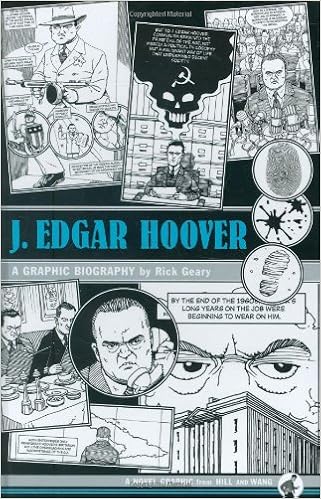
Geary, Rick (2008) J Edgar Hoover: a Graphic Biography.  New York:  Hill and Wang.


Opening lines:  For 55 years, J Edgar hoover served the people of the United States , much of that time as a national icon."

            J.Edgar Hoover’s career in the FBI spanned over 5 decadess.  During that time he was seen as a bureaucrat, a leader, a hero, a moral crusader, a commie-buster, and a paranoid and vindictive man.  In this graphic novel, Rick Geary manages to present all of these aspects of the famous G-man in a relatively balanced way.  In Geary’s narrative, Hoover begins his career as an erstwhile and dedicated young lawyer working for the Attorney General during World War Two.  Hoover’s intelligence and organization allow him to advance rapidly in the organization and his careful political awareness allow him to work for such diverse chief executives as Warren Harding, Calvin Coolidge, Franklin Roosevelt, Harry Truman, Dwight Eisenhower, John F. Kennedy, Lyndon Johnson, and Richard Nixon.  Geary lauds Hoover’s early work, but doesn’t shy away from addressing Hoover’s descent into paranoia. 
            This graphic novel would be useful to high school students, but is clearly written for a more adult audience.  Gary acknowledges the frequent allegations of Hoover’s alleged homosexuality and possible mis-allocation of funds—but he neither dwells on it nor depicts it in a sensational way.


Pope, Paul (2008)  Heavy Liquid. New York: Vertigo.


Opening lines:  "Parade outside.  I've got nothing to celebrate."

S has stolen a bunch of a new drug called heavy liquid from the dealers who he acts as a courier for.  Now they are hunting him.  S is looking for a chance to go into hiding.  So when a fantastically wealthy art collector wants to hire him to find a missing sculptor, S agrees, even though the missing artist is his ex. 
            The art in this graphic novel is strong.  Although it is mostly black and white with spot color, the gritty shadowy style which is typical of Pope is interesting to look at  (though it may be a bit inaccessible for new graphic novel readers.

            This book is pretty much a noir action story which will grab edgy graphic novel aficionados. .  There isn’t a whole lot going on here thematically, but some high school readers will like the story and the art.  There is some vulgar language, drug use, and smoking in this story (though no nudity or sex).  Non-graphic novel readers and those younger than high school might have trouble following the story. 

Friday, January 8, 2016

Powerful Novel by Gary Schmidt!

Schmidt, Gary D. (2015)  Orbiting Jupiter.  New York: Clarion.


Opening Lines: "Before you agree to have Joseph come live with you," Mrs. Stroud said, "there are one or two things you ought to understand."  She took out a State of Maine Department of Heath and Human Services folder and laid it on the kitchen table."


The social worker warns Jack (and his parents) that his new foster brother might have some problems.  It turns out that Joseph has served time in two different juvenile  halls, while in one he tried to kill a teacher, and even though he like Jack, is in middle school, Joseph has another thing that makes him different.  Joseph has a three month old daughter that he has never seen.

When I first read this book, I was looking for a powerful voice like the one in Schmidt's Okay for Now.  The power of this book, though is more subtle, so much so that you almost don't notice it.  As you follow Joseph and how he is at the same time enfolded into his new foster family, and further separated from his daughter who he desperately wants to see, the story gets more and more powerful.
There are also some absolutely delightful connections to Schmidt's earlier books.  And like Schmidt's earlier books, this one does a great job of immersing the reader in a community.  But none of that is what makes the book great.

Um,  Actually, I don't know why it's such a good book.  I could say it has something to do with the themes of borkenness and grace.  I could say that it rings true.  I would say that it is an emotionally powerful book, but all of those ways of describing it fall short.  It is a book that has a lot to say about what love is.  But that sounds ridiculous.  Look, bottom line, you are just gong to have to read it.

This is a tricky one in terms of whether you can put it in your classroom library.  The fact is, the main character and a girl his age have sex, and though that action is not described in the book, one of the questions the book asks is whether two kids that young can really feel love for each other.  The book also asks whether we could allow such a person as Joseph to have a part in the raising of his daughter.  I think this is a book that should be in classrooms, probably starting at middle school, but some parents might object to it on the grounds that it is introducing children to ideas they should not be thinking about.  Having read the book, I would have no hestitaiton about my 6th grade daughter reading it, but I can respect parents who feel differently, and teachers should be aware of that possibility.

Still, even if you can't put this book in your classroom, you ought to read it.  You'd really like it.


Wednesday, December 30, 2015

Best Action Adventure Adolescent Novel with a Bat Protagonist Since Silverwing!

Oppel, Kenneth (2000) Sunwing  New York:  Aladdin.


Opening Lines:  "Wings trimmed tight, Shade sailed through the forest.  The naked elms, maples, and oaks blazed in the moon's glow, their branches spiked with icicles.  Beneath him, trees lay toppled like the skeletons of giant beasts.  The groans of freezing wood filled the air, and in the distance Shade heard a mighty crack as yet another branch snapped and fell."

Shade is a bat, a particularly good, gifted, and courageous bat.  As the book opens, he is tryng to protect his family and avoid war with the owls.  On the run from a force of owls, Shade leads his family through what seems to be a cave and into what appears to be a bat paradise.  It is an indoor jungle with all the food and nesting sites they could ever want, and no owls.  One night when he is asleep, however, Shade wakes up to the sight of humans gassing some bats and pulling them from their roosts. With the help of Marina. a female bat that Shade won't admit to himself he is rather fond of, Shade discovers that they are being held in what is essentially a giant bat trap and that the humans are operating on the bats, implanting explosive devices in then, then dropping them from planes to destroy cities.  Shade must convince the other bats to escape, avoid capture and implantation save the bats that have already been operated on and their targets, prevent a war with the owls, and outwit Goth, a vampire bat bent on ruling the bat kingdom and eventually the world.

Sunwing is a well-told and gripping story.  It has enough action and adventure to keep kid's attention, but at the same time, Shade grows from an insecure young bat who worries about his small stature to a bat who learns to be confident in his strategic and leadership abilities, learns to stand up for what is right and persuade others to follow that path as well, and comes to understand that Marina likes him not in spite of what he thinks of as his flaws (compassion, thoughtfulness, and other traits) but because of them.

When they are trapped in the bat environment, there is a group of bats who are following a kind of a fatalistic cult that teaches that the missing bats are sacrifices that need to be made in order to enjoy their luxurious lifestyle.  Readers with an axe to grind might perceive this as an attack on organized religion, but the rest of the story doesn't bear that out.

Strong second grade readers will be able to make it through this book (though it might work best as a read-aloud for that age.).  Third through middle school will enjoy it.  Though the book is targeted to boys, girls who enjoy fantasy and/or nature will also find it captivating. There are two other books in the series that I know of, Silverwing and Firewing.  I recommend them all.


Friday, December 11, 2015

Nerd Stories!

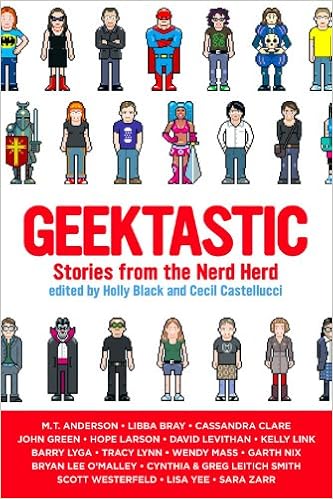
Black, Holly; Castellucci, Cecil (editors)  (2009) Geektastic:  Stories form the Nerd Herd.  New York:  Little Brown.


Opening Lines:  "I awake tangled up in scratchy sheets with my head pounding and the taste of cheap alcohol and Tabasco sauce still in my mouth.  The spirit gum I used to attach my nose ridge and eyebrows sticks to the sheets as I roll over."

I am a nerd.  I have never felt bad about that, though my younger brother, looking out for me, has told me repeatedly that I am not a nerd.  The problem comes in definitions.  When I define a nerd, I think of someone who loves to learnt who  and read and is willing to jump into life with both feet, unafraid of looking foolish.  I think of someone who is willing to admit publicly that he or she loves Shakespeare and legos and the Periodic Table and comic books, and Plato and Star Wars and historical reenactments and so on.

My brother might define a nerd as someone who has trouble fitting in, who dresses unstylishly, who says awkward and embarrassing thing in public, and who lacks social skills.

Other people think of a nerd or a geek as someone who engaged in pop cultural texts that mark them as an outsider -- someone who dresses up like a klingon and goes to comic book conventions, or someone who gets together with their stormtrooper unit every weekend, or someone who is a member of the Society of Creative Anachronism and travels miles to participate in mock sword fights on the weekends.

Editors Holly Black and Cecil Castellucci gathered some really impressive authors and asked them if they could write about the broad subject of geekiness and nerdiness.  Some of the authors who appear in this volume are M. T. Anderson (the Octavian Nothing series), John Green (Fault in Our Stars, An Abundance of Katherines, etc.), Hope Larson (who wrote an excellent graphic novel adaptation of A Wrinkle in Time), Garth Nix (Sabriel series), Scott Westerfield (Uglies, Leviathan) and many others.  Perhaps as a result, the topics of stories (and definitions of what it means to be a nerd) cover quite a range.  One of my favorites is a touching story about a shy but huge teenage bay who is part of a Society for Creative Anachronism group styling himself as "the Quiet Knight", He is quite taken by a girl in the group and later sees her at school and is able to sort of come to her rescue.  There are other stories about a Rocky Horror Picture Show aficionado, two best friends on the run from a nerd-hunting game, several stories of nerd love (the best kind), a cheerleader who decides to become a Star Trek fan, and one about a kid who goes to confront his favorite science fiction author about the possibility that author may have had an affair with the fan's mom.

 Clearly these are PG-13 rated stories (and maybe one or two that come close to being R rated), and this book is certainly not one that would work to study as a class.  But for students who may find some of themselves in some of the characters here, this book may be a good way to remind the non-conformists, the different, and those who really love learning, that they are not alone.


Monday, December 7, 2015

Excellent Graphic Novel About a Fifth Grade Girl Who Loves Roller Derby!

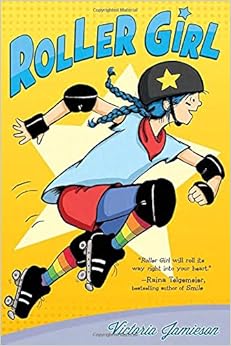
Jamieson, Victoria (2015) Roller Girl.  New York:  Penguin.


Opening Lines:
Girl 1:  "Ugh, there's only Astrid here.  I told you only babies hand out at the park."
Astrid, lacing up her skates, shoots them an angry look.
Girl 1:  Come on, Let's go to the mall.  I don't know why you wanted to come here anyway."
Astrid clicks on her skate helmet.
Suddenly Astrid is larger than life and skating toward them at the mall.
Astrid:   "Better call mall security, you jerks!"
The two girls run screaming.
Girl 1:  "Aaaaaaaagh!"
Girl 2: "OMG, I chipped a nail!"
Next page, daydream vanishes,   Astrid is skating by herself on a sidewalk.  Astrid:  "Sigh."

I would have reviewed this book months ago, but it has been impossible to get it away from my sixth grade daughter long enough for me to read it.  This is a remarkably good graphic novel -- and one that will especially grab the sorts of readers who loved Raina Telgemeier's Smile and Drama and Sisters.  Jamieson weaves a wonderful tale about Astrid's growing interest in roller derby, participation in a Saturday skating camp, and eventual growth and mastery of the sport.  Along the way she gains and loses friends, struggles with the skills not coming to her as smoothly as she things they should, deals with being jealous of her friend's success, and grows with the support of an older mentor.  This graphic novel has a beautiful balance of action and relationships and is sure to be a hit with fourth grade girls on up (and maybe some boys as well).

The art reminds me a lot of Raina Telgemaier's style. The characters are just the right combination of realistic and cartoony.  The inviting and colorful style adds to the excitement of the story.

In the story, When Astrid has an argument with her friend Nicole and Nicole chooses not to go with her to Roller Derby Camp, Astrid doesn't tell her mother that Nicole's family will not be driving Astrid home.  As a result, Astrid has to walk the couple of miles home.  It is a great lesson in perseverance, but also in the value of communicating with your parents.  Some parents may have issues with this deception. There are good themes in the book as well though.  Astrid seeks help from adults when she needs it, learns to stand up for herself, learns the value of sticking with something she cares about, and learns a lot about friendship.  Once or twice in the book there is a vulgar reference (one of her rivals calls Astrid "Ass-turd" at one point) which might argue against including it in your classroom library.  All in all, though, it seems to me to be an excellent book for upper elementary and middle school students.