Monday, January 30, 2017

Three New Graphic Novels Worth Reading (Good for Science, Theology/philosophy, and English classes)

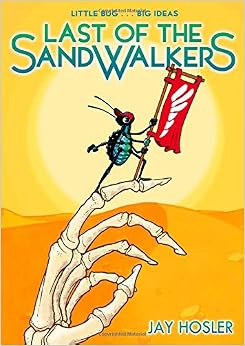
Hosler, Jay (2015) Last of the SandWalkers  New York:  First Second.

Image result for last of the sandwalkers

Opening Lines:

"Lucy's Journal.  February 15th, 1002 PC (Post Coconut)
            We left New Coleopolis this morning with no fanfare.  Leading the first mission to seek out life beyond our oasis should have been the greatest moment of my scientific carrer.  Instead we shuffled out of town like wriaths through the morning mists. It's just as well, though since most of our colleagues are convinced we will fail."

Joy Hosler is the amazing biologist/graphic novelist whose first work, Clan Apis, follows two worker bees that are part of a colony.  In Last of the SandWalkers, Hosler here gives us a much fuller story of several beetles who leave their safe home and go out into the desert on a voyage of discovery.  Lucy is the plucky leader. Professor Bombadier is her resourceful mentor, Raef is a robotic firefly, And Mossy is a relatively huge horned beatle.  Along with them is treacherous Professor Owen.  As they journey on what turns out to be an epic adventure, the reader learns a great deal about entomology in general and beetles in particular -- including about trap-door spiders, whirligig beetles, and what it is like to get caught in amber.  Not that the learning gets in the way of the story -- which has enough twists and turns and moments of danger to easily keep students' attention.

The images and panel movement draw the reader naturally into the story.  The art serves the story so well that it is easy not to notice how really accomplished the black and white drawing is.

This book is probably best for middle school and up and could be valuable for middle school and high school science and biology classes -- both as a classroom text to consider ecosystems and adaptation, but also as a supplementary book for kids who love to read.

These is nothing here likely to cause a challenge -- though extremely careful readers may catch that Hosler takes a swipe at the sort of fundamentalist religion that sets itself up in oppostiion to science -- but because it is a made-up beetle religion and doesn't appear to be targeting any particular faith, it is unlikely anyone would object.

This is a really good one.


Kashyap, Keshni; Araki, Mari ((2012) Tina's Mouth:  An Existential Comic Diary.  New York:  Houghton Mifflin.
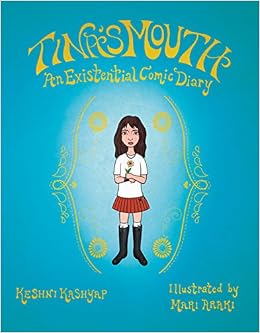
Image result for tina's mouth an existential comic diary

Opening Lines:  "January 26.  Dear Mr Jean Paul Sartre,  I know that you are old and dead and also a philosopher.  So, on an obvious level, you and I do not have a lot in common."

So begins Tina's Mouth, a graphic novel that takes us inside the life of a high school sophomore trying to make sense of religion and beleif  and the meaning of life by keeping a diary of her existentialism. She tries to make sense of all this while living through losing friends, having crushes, losing crushes, and trying to figure out how life works.

The book is just barely a graphic novel.  Some pages have a single image and a large section of separated text.  Instead of regular panel movement, there are sometimes inset panels in panarama double-page spreads.  The lettering is typeset instead of drawn, and the illustration sometimes reminded me of paper dolls in that they seemed to have a limited range of movement.

Tina's search for meaning and friends and love is touching and certainly evocative of the searching that many readers may remember from their young adulthood.  There is no real resolution of Tina's search, though, save an acceptance that she doesn't really understand existentialism and that her search will go on.

This book is probably best for high school-aged readers, though teachers should be warned that there is enough vulgar language here that a parental challenge might be likely.  The language is nothing more than you would hear in many high school campuses, though other than verisimilitude, it doesn't seem to serve any thematic purpose.

This might be a good one to check out from your local public library before buying.


LaBoucane-Benson, Patti; Mellings, Kelly (2015) The Outside Circle.  House of Anansi Press.

Image result for the outside circle

Opening lines:  "Today is the first day of the Warrior Program.  We are going to start today with a smudge and a prayer.  It's important to make these offerings as we ask the creator for help."

Pete Carver is an indiginous Canadian whose one wish in life is to take care of his younger brother Joey. Pete's mom is a heroin addict.  Pete himself runs with a gang and is involved in selling drugs.  When his girlfriend tells him she is pregnant, he tells her the baby probably isn't his and kicks her out of the car.  Then one night, during a fight with his morher's boyfirend Dennis, things get out of hand, Pete kills Dennis and is sent to jai.  Pete asks his fellow gang members to take care of his little brother.  In prison, things get worse.  When Pete find out the gang is putting Joey at risk and there  is nothing he can do about it, he is ready to do something rash.  Instead he finds out about a rehabilitation program that uses traditional tribal worship to help people learn to deal with their anger and get themselves straightened out.  Pete has to face his brokenness, acknowledge his anger, and eventually make a choice aobut how he wants his life to go.

The art in this book is beautiful.  The story is engrossing (it isn't an easy journey for Pete at all).  The scenes are painful to look at sometimes, but in order to value Pete's eventual triumph, we have to be there in the bad parts too.

There is some vulgar language in here, but it expresses the hardness of Pete's world and his own bitterness, and it is something I would fight for.  This book might be a good choice for a high school English classroom, especially when paired with another book about mistakes and redemption (Paul Fleishman's Whirligig for example).  This one is well worth buying. 


Friday, January 20, 2017

Three quick reviews -- good books for middle elementary

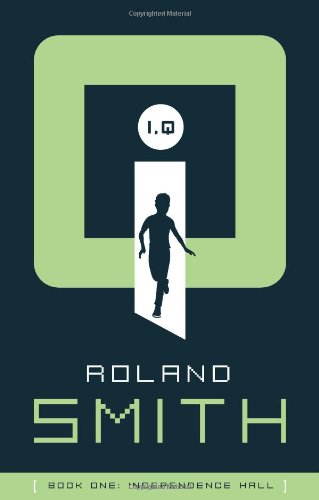
Smith, Roland, (2008)  IQ: Independence Hall.  Ann Arbor:  Sleeping Bear Press

Image result for iq roland smith

Opening lines:  "From a window across the street, Eben Lavi watched the couple and the two children leave their loft and climb into the back of a white limosine.  It pulled away from the curb and started down the street.  A moment later a blue SUV fell in behind the limo, three cars back, and began to follow."

Q and his step-sister Angela are the children of famous rock star parents.  When they are on tour with their parents, the coach bus breaks down and an old drifter shows up and fixes it.  Their parents explain that the drifter is actually Boone, and old roadie friend of theirs.  Soon Q and Angela find out there is more to Boone than meets the eye and before they know if they are caught in the crossfire between Israeli secret-service operatives and a group of ex-FBI mercinaries.  And underneath it all are some surprising revelations about Angela's late mother.

This book has all the excitement of an action adventure spy movie, but, one that is maybe with the violence is toned down, a bit more humor, no offensive language and a story that is perhaps a little easier to follow than a typical YA spy novel.  There are several other books in the series.  This is a good one for stronger readers in fourth and fifth grade especially.   I suppose some parents might object to the way that Q and Angela deceive their parents from time to time.


Quattlebaum, Mary (1996) Jazz, Pizzazz, and the Silver Threads.  New York:  Bantam.

Image result for Jazz, Pizzazz, and the silver threads

Opening lines:  "Each time Jenny clicked her magic wand against the table and --whoosh-- a scarf appeared, Calvin felt his attention click up from his history book and whoosh away."

Okay, so the writing on this book didn't win any awards, and the story isn't utterly gripping, but it is about a nine-year-old boy named Calvin whose quest for a pet leads him to care for his nieghbor Jenny's pet hamster, and, when that plan goes awry, Calvin is soon organizing a jazz concert with geriatric dancers in a desperate bid to keep the hamster.  Wacky hijinks ensue.

This is a story that may well make seven- to ten-year-olds laugh.  They may enjoy the social interaction in the book.  And it is short enough at 120 pages that it might be managable for a struggling reader.  Plus it involves a pet hamster.

Nothing offensive here at all.


Gannett, Ruth Stiles (1948) My Father's Dragon  New York: Random House.

Image result for My Father's Dragon

Opening Lines:  "One cold rainy day when my father was a little boy, he met an old alley cat on his street.  The cat was very drippy and uncomfortable so my father said, 'Wouldn't you like to come home with me?'"

So begins the story of the father, Elmer Elevator, who undertakes a mission to Wild Island to rescue a dragon that is unjustly imprisoned there.  For this vital mission, Elmer packs into a backpack: "...chewing gum, two dozen pink lollipops, a package of rubber bands, black rubber boots, a compass, a toothbrush and toothpaste, six magnifying glasses, a very sharp jackknife, a comb and a brush, seven hair ribbons of different colors, an empty grain bag with a label saying "Cranberry", some clean clothes, twenty-five peanut butter and jelly sandwiches and six apples."  The story which follows is improbable, involves outwitting animals, ends with a freed dragon, and is silly and sure to be a hit with first and second graders who have good senses of humor.

This is a classic.  Nothing offensive here.  Might be worth a look.


Friday, January 13, 2017

Two Graphic Novel Collections that are Kind of Cool and the Return of the Stratford Zoo

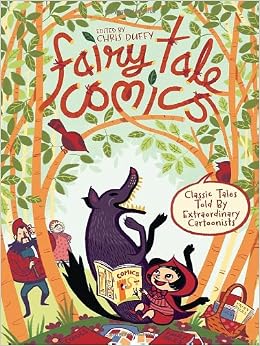
Duffy, Chris (ed.) (2013) Fairy Tale Comics.  New York:  First Second.

Image result for Fairy Tale Comics

Opening lines:  Once upon a time there was a poor little girl named Emma who lived in a poor little town where everyone was hungry and spent their days dreaming of sweet porridge."

This book has seventeen fairy tales, each illustrated in graphic novel form by a different artist.  Here you will find well-known standards like "Little Red Riding Hood" (adapted by Gigi D.G.); "Snow White" (adapted by Jaime Hernandez), "Rapunzel" (adapted by Raina Telgemeier) and others.  There are also some tales that might be unfamiliar to you.  I particularly liked "The Prince and the Tortoise" (adapted by Ramona Fradon and Chris Duffy), "Give Me the Shudders" (adapted by David Mazzucchelli) and "Azzolino's Story Without End" (adapted by Chris Thompson).

I can't say every single story in here will be to your taste, but the vast majority of them take you quickly into the world to the fairy tale and illustrate the stories in a way that is compelling, funny, and faithful.

The age level for this one is a bit tricky.  It is far easier to read aloud a picture book than a graphic novel (though it can be done), and there are some visual puns that the littlest kids won't get -- but I am guessing tht there are some stories in here that would be well-suited to kindergarten or first graders, and other stories that would grab older students in third or fourth grade.  Middle school and high school students might be able to use it as a reference (I remember asking my drama students to present a folk tale or fairy tale and being surprised how unfamiliar they were with the genre.)

This is a beautiful, silly, and sometimes just-a-tiny-bit-scary book and worth picking up.


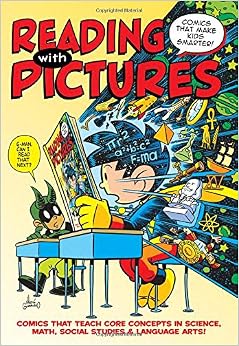
Josh Elder (2014)  Reading with Pictures:  Comics that Make Kids Smarter. Kansas City: Andrews McMeel Publishing

Image result for Reading with Pictures: Comics that Make Kids Smarter

Opening lines:  "Fifteen years ago I began teaching high school and self-publishing comics at around the same time"  (From Gene Yang's Forward.)

It is kind of a paradox.  We learn so much from reading stories, without even working at it.  But when stories are written to try to teach us something, we sense the inauthenticity and the lack of faithfulness to the story and we reject the teaching.

This book began with a cool idea -- use the graphic novels format, which kids enjoy so much, to engage kids in school subject areas.  However, each piece in this collection has to make a decision about where in the continuum from being mainly about the story to being mainly about the content being taught.  And where they come down on that line determines whether each story works or doesn't.

The first story in the collection, for example, "G-Man: Reign of the Robo-Teachers" is a fun little story of what happens when robots take over the teaching duties in a school and the kids hack into their operating system.  It is a great story with colorful and interesting art.  I doubt there is much academic content to learn from this one, though.  The very next story, "The Power of Print" reads like a dull filmstrip about how humans devleoped writing.  Lots to learn here, but nothing like an engaging story, particularly with lines like "Writing has allowed for the development of society -- would we have cities and governments without a written language?"  The artwork, in evenly-spaced panels and consisting of a subdued wash of color does little to grab us either.  Most of the stories fall somewhere in the middle, as in the story of "Albert the Alien" which uses a class scenario with a foreign exchange student from another planet to teach about idioms and literalism for language arts class.

The other issue for teachers with this collection is that, even though it has 16 different stories covering language arts, science, mathematics, and social studies, that only works out to three or four stories per subject.  So while it is a good book for the back of a third through sixth grade classroom, it is not the sort of book that would likely be used to teach a lesson or a unit.


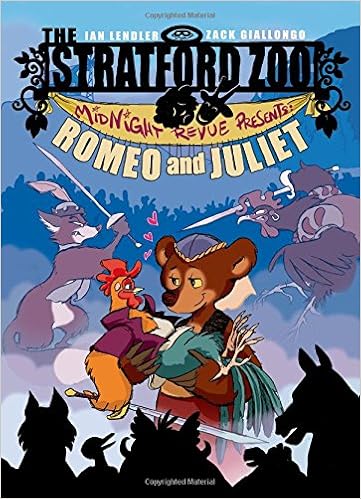
Lendler, Ian; Giallongo, Zack (2015)  The Stratford Zoo Midnight Revue Presents Romeo and Juliet.  New York:  First Second

Image result for Stratford Zoo Midnight Revue Presents Romeo and Juliet

Opening lines:  Banner:  Big Bill Shakespeare's Romeo and Juliet:  A most excellent and woeful tragedy!  A tale of ancient grudges and the true love of good friends.
Little Monkey: "Mom, what's a woeful tragedy?."

The first book in this series, an adaptation of Macbeth, was hilarious.  This one is at least as good and maybe better.  The zoo animals of the Stratford Zoo are once again putting on a play.  This time it is about Romeo the Rooster, prince of the petting zoo, who meets Juliet, a bear from the woods, and they decide they want to be friends.  Unfortunately, bears can never be part of the petting zoo, and if creatures from the petting zoo come to the forest, they will be eaten alive.   Star-crossed lovers indeed.

Lendler and Giallongo handle the violence in the play in a way that uses humor to avoid anything that might be troubling.  For example, after the death of Mercutio, Romeo grabs a sword and flies at Tybolt the fox, but at that moment, two elephants arrive late for the play and as they are crossing to their seats, we miss the entire battle.  The next panel shows Tybolt the fox lying on the ground with his tongue hanging out, hands clasped over his chest, holding a lily, and Romeo the Rooster standing over him with a sword saying "Whoops."

I don't know what age the book was originally intended for, but it seems to me it would work well with third grade and older.  There is no offensive violence in the book, though there is a point where a donkey character is rightfully called an ass, and another point where Juliet says, "Well, this sucks."  Most communities probably would not be terribly bothered by that though.

It is a great way for younger readers to tackle the story of Romeo and Juliet so they will be ready when they get to read the real thing.


Saturday, January 7, 2017

Children's Literature Booklist for this year

So this is the list of books that I will be using in Children's literature this year.  I think it will be the last year for Sherman Alexei's The Absolutely True Diary Part Time Indian.  It is such a good book, and I have kept it on the list for such a long time, but ten years old is pretty much my limit.

Anyway, here is the list:

Alexie, Sheman (2007)   The Absolutely True Diary of a Part-Time Indian.  New York: Little, Brown 
 
Image result for the absolutely true diary of a part-time indian

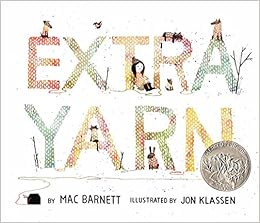
Barnett, Mac; Klassen, Jon (2012) Extra Yarn. New York: Harper Collins 
Image result for extra yarn

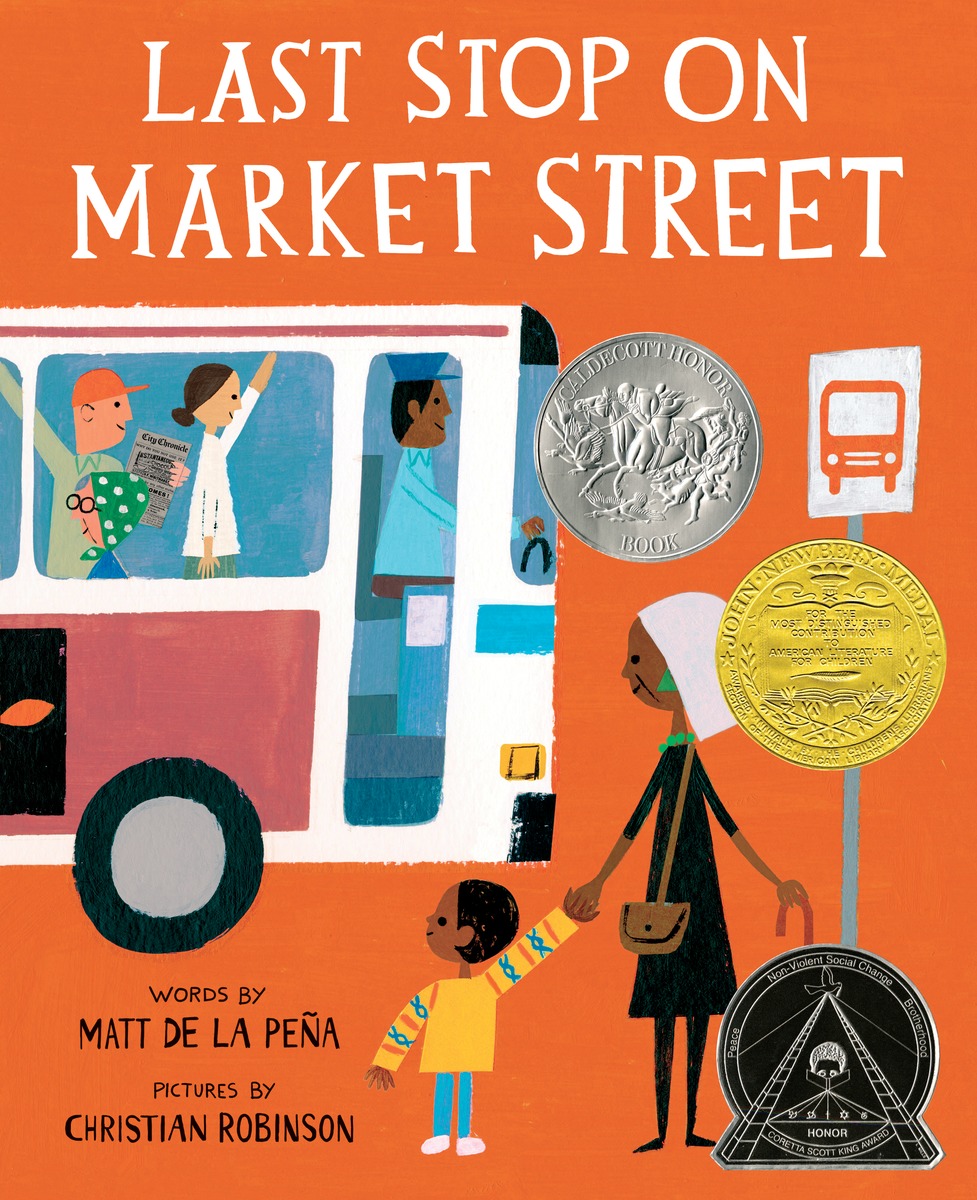
De la Pena, Matt (2015) Last Stop on Market Street.  Putnam. 
Image result for last stop on market street

Hatke, Ben (2016) Mighty Jack.  New York:  First Second. 


Jamieson, Victoria (2015) Roller Girl.  New York: Dial 
 

Klaasen, Jon  (2012)  This is not my Hat  New York:  Candlewick. 
Image result for this is not my hat

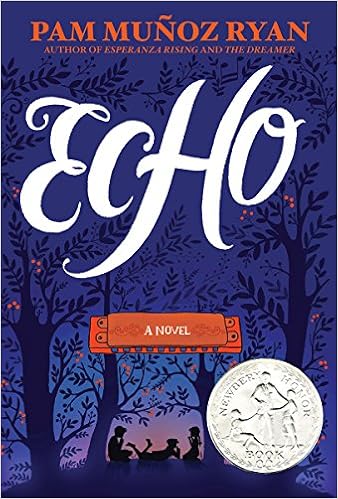
Ryan, Pam Munoz (2015) Echo. New York:  Scholastic. 
Image result for echo pam munoz ryan

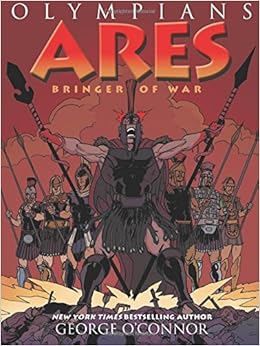
O’Connor, George (2015) Ares: Bringer of War.  New York: First Second. 
Image result for ares bringer of war
 

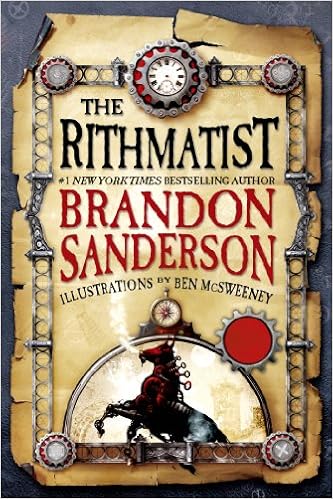
Sanderson, Brandon (2013) The Rithmatist.  New York: Tor
 Image result for The Rithmatist

Santat, Dan  (2014) The Adventures of Beekle, the Unimaginary Firend.  New York:  Little Brown 
Image result for the adventures of beekle

Schmidt, Gary (2011) Okay for Now  New York:  Clarion 
Image result for okay for now

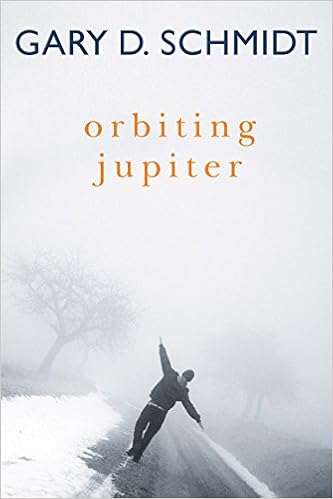
Schmidt, Gary (2015) Orbiting Jupiter. New York: Clarion. 
Image result for orbiting jupiter

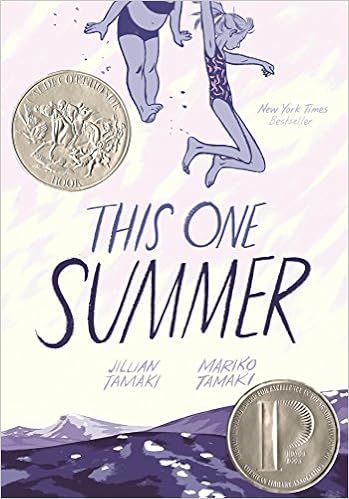
Tamaki, Jillian; Tamki, Mariko (2014)  This One Summer.  New York: First Second 
Image result for this one summer jillian tamaki

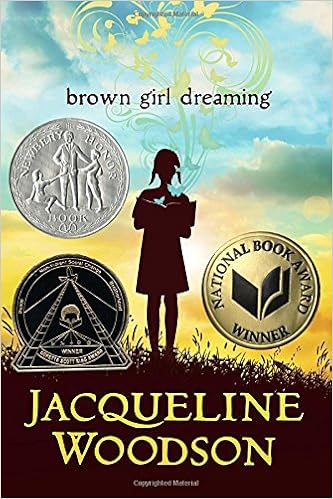
Woodson, Jacqueline (2014) Brown Girl Dreaming  New York: Penguin.
Image result for brown girl dreaming


Wednesday, January 4, 2017

The most amazing book about autism you have never heard of!

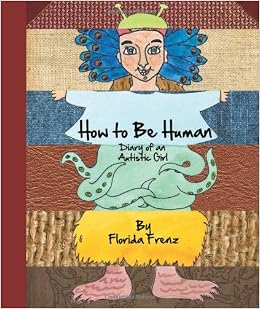
Frenz, Florida (2013) How to be Human:  The Diary of an Autistic Girl.  Creston Books.

Image result for how to be human diary of an autistic girl

Opening lines:  "Not too long ago, my friend and I had a discussion about which was worse, anorexia or autism.  She argued anorexia was worse because it can kill you.  At the time, I couldn't come up with a good enough rebuttal, so the conversation ended."

Books can let us enter the minds, bodies, selves, and contexts of those who are different from us. Some recent books like The Curious Incident of the Dog in the Nighttime and The Speed of Darkness admirably use fictional characterizations to get us inside the minds of people who have autism.  This book is different from those in a couple of ways.  First of all, the author, who goes by the name Florida Frenz, is herself autistic.  Secondly, she wrote the book as she was growing up with autism. So it is truly from a kid's perspective.

 It includes a running narrative, her own illustrations, and several charts of the author's devising.  Her illustrations show us how, when she hears the sound of fingers snapping, it feels to her like "pushing soapy plates together"; the difference between the way she looks on the outside and what she feels like on the inside; what her internal emotional thermometer looks like; and lots of images of how she tries to navigate the differences between outside appearances and inside feelings.

This is not a long book -- it is bound like a children's picture book and comes out somewhere between 30 and 40 pages --but it is not really written for little kids.  Though the images break up the space of the page, there is a fair amount of text here.

This book would be great for upper elementary through college (and beyond) to help classmates, family members, friends, persons with autism, anyone who has ever felt like an alien in their own land, and pretty much anyone understand what one autistic person's take on life is like.  I found it interesting and compelling and well worth the read.

Friday, December 2, 2016

Amazing Novel for High School History, Music, and English teachers

Anderson, M.T. (2015)  Symphony for the City of the Dead:  Dmitri Shostakovich and the Siege of Leningrad.  Somerville: Candlewick.

Image result for Symphony for the City of the Dead

Opening lines:  "An American agent met with a Russian agent one bright summer morning when the world was collapsing inthe face of Nazi terror.  It was June 2, 1942, the Second World War was not going well for the Allied forces.  Most of Europe had already been conquered by the Nazi German onslaught.  France had fallen, and so had Norway, Denmark, Poland, Belgium, and Czechoslovakia.  Now the Germans were deep inside Russia, clawing away at the country's innards."

In Symphony for the Dead, M.T. Anderson (author of Feed, Octavian Nothing, and the hilarious Jasper Dash books) takes us to the depths of despair and starvation, and to the unlikely possibility that a nervous and starving Russian composer in the besieged city of Leningrad could, through the music of a symphony, give Russians enough hope to turn the tide of the war.  Anderson has never underestimated the ability or maturity of an adolescent or young adult reader, and make no mistake, this non-fiction regular text book (that is to say, it is not a graphic novel) is a  challenging one.  But it is also utterly gripping,  From the opening story of how Allied spies smuggled Shostakovich's symphony to American shores to the flashback story of Shostaokovich and his struggles to survive as a musician in the schizophrenic would of Russian fine arts under the paranoid and monomaniacal Lenin, this book is gripping.  In these pages, you will find the tragic story of Lenin, who trusted no-one, and how he decided to trust Adolph Hitler who declared he would never invade Russia.  Lenin's trust was so strong that even as the Germans were striking deep into Russian territory, killing Russian soldiers and destroying Russian planes and airfields as they went, Lenin forbade Russian soldiers to return fire.  Here you will find the story of the desperate conditions within the besieged city of Leningrad and how people ate furniture glue, shoe leather, and eventually turned to cannibalism to survive.  But here you will also find the hope of a symphony which kindled Russian hope and encouraged the Americans to come to their aid.

This book might work as a supplemental text in a high school classroom, but I think it would be far more successful as a go-to book for that student reader in your class who is obsessed with history or music and wants to read a powerful story without any sugarcoating.

Though as I mentioned before, there is some talk of canibalism, it is certainly not celebrated.  Though there is despair here, there is also hope.  While not well suited to younger kids, if it was used in the high school, this book would be unlikely to be challenged.

The writing is superb, the story is gripping, and it is probably the best book I have read this year.  Buy it.

Wednesday, November 23, 2016

Graphic Novels: D-Day, Artemis Fowl, Amelia adaptation, Shakespeare, and Vampires

Capa, Robert; Morvan, Jean-David; Trefouel, Severine (2015)  Omaha Beach on D-Day.  New York:  First Second.

Image result for Omaha Beach on D-Day Capa

Opening Lines:  "January 27, 1944.  Italian front, three miles from Cisterna di Latina.  The allied troops were unable to advance, immobilized by the Wehrmacht's fierce resistance. The Americans had blanketed the area with artificial fog to hide their positions from the German artillery.   I was determined to make the most of the situation."

This is not a graphic novel about the invasion on D-Day, although it includes that.  This graphic novel is the story of a war photographer, Robert Capa, who went along on the D-Day invasion and got some of the best photographs of that action.  Combining black-and-white comics with excellent reproductions of Capa's photographs, and including some regular-text essays, this book follows Capa through the end of the war and a bit beyond.  Along the way we see him interact with everyone from common soldiers to General Eisenhower and the writer Earnest Hemingway.  The book also takes an interesting digression to figure out which soldier was in the iconic photo of an American soldier swimming to the Normandy shore, pushing a life preserver in front of him.

This book will not give you a full historical and strategic overview of the invasion that turned the tide of World War Two, but it will take you deeply into one man's perspective.  Although the text is a secondary source biography, the photographs reproduced in the book offer an excellent opportunity to allow history students to consider the value of photographic primary sources and the research required to fully understand them.  The photos are, it must be said, spectacular.

There is plenty of smoking and drinking in this book (as there was in World War Two) and some fairly vague references to Capa's amorous affairs, but this book should be suitable for fifth or sixth grade and up and is unlikely to prompt any challenges.

If you know a child who loves World War Two, photography, or journalism, I would encourage you to get hold of this one.


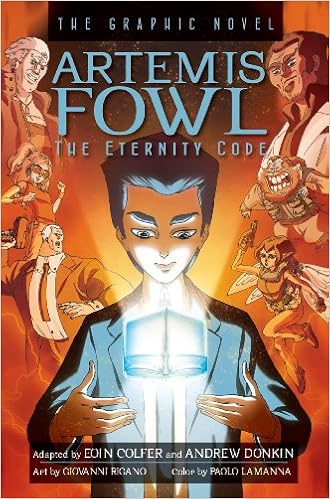
Colfer, Eoin; Donkin, Andrew ((2013)  Artemis Fowl:  The Eternity Code.  New York:  Hyperion

Image result for artemis fowl the eternity code

Opening lines:  "Excerpt from Artemis Fowl's Diary, Disk 2.  Encrypted.  My name is Artemis Fowl and I am a genius.  The last two years have been exhilarating, even by my own high standards.  It had all started with the internet, but then these days, it always does."

In this adaptation of the third book in Colfer's excellent series, Artemis Fowl tries to sell a underworld investor the chance to get ahead of the market on Artemis's latest invention, a computer cube that makes smart phones look dumber than dirt.  When the deal goes bad, Artemis's faithful bodyguard, Butler, takes a bullet meant for him and the criminal gets away with the cube., Artemis must enlist the help of Captain Holly Short of the Lower Elements Police Recon (that's LEPrecon); Foaly the technical genius centaur; and the flatulent dwarf, Mulch Diggums to try to get it back.

This is a rip-roaring action graphic novel, but one that requires a fair amount of thought from the reader to understand the levels of subterfuge involved in reclaiming the cube.

Though this is a violent graphic novel, it pales in comparison to the tamest violent PG 13 film.  It is probably best for fourth grade and up.  Artemis consistently employs logic to make his decisions, which may be useful for high school math classes doing a unit on logic.

This is a fun one.  I recommend it, especially for classroom libraries.


Spender, Nick; Haynes, Stephen (2008) Macbeth  Brighton, UK: BOok House..

Image result for Macbeth Nick Spender

Opening lines: "When shall we three meet again, in thunder, lightning, or in rain?   When the hurley-burley's done, when the battle's lost and won.  That will be ere the set of sun.  Fair is foul and foul is fair; hover through the fog and filthy air."


A couple of years ago, my amazing student Courtney R. was spending a semester in London and I asked her to keep her eyes open for any graphic novel adaptations of Shakespeare's plays.  She brought back this one and inscribed it with a kind note and an apology.  "Sorry if this version isn't the best."

I finally got around to reading it a week ago and I have been trying to figure out ever since whether this version is the best, the worst, or somewhere in between.  The illustrations are very thoughtfully done in a way that makes them both exciting and faithful to the book.   Spender favors light from fireplaces and dark shadows to give the whole play an authentic and creepy quality.  And it would be a great way for students to get to know Macbeth in the way it is traditionally presented (that is to say, not with updated costumes and sets to make it look like it is taking place in Vietnam, the moon, or downtown Cleveland.)

Unfortunately, however, the creators made the choice to typeset the words rather than have them be hand-lettered in classic comic book tradition.  That might not seem like a big deal, but that lettering allows the graphic novel text to carry more emotion and emphasis (even though we often don't consciously notice it when we are reading.)  This version, though, will strike you as cold and sterile because of the type.  The other drawback is that in this adaptation they have cut out Lady Macbeth's speech about being determined enough in the murders to "rip the babe from her breast" and also the gatekeeper's speech about the effects of drink.  While that makes it easier to put this version in your classroom library without fear of a parental challenge, it leaves out two scenes that are considered by many to be important parts of Shakespeare's play.

If you are teaching Macbeth, I would encourage you to have a look at this version.   It may be a very helpful tool for you.


Gownley, Jimmy (2006) Amelia Rules: What makes You Happy and Amelia Rules: Superheroes.  New York:  Atheneum.

Image result for Amelia Rules

Opening lines:  "It's weird...  In a way, I can't believe fourth grade is over.  But on the other hand, I can't believe it took so long. Every day you sit in class and the clock seems to stand still.  Then one day you look behind you and wonder where it all went."

First, a clarification.   This is not the same Amelia who graces the pages of Melissa Moss's excellent Amelia's Notebook series.  There are some great things about this Amelia.  She is plucky, we get to share her frustration with some aspects of life, and she is sometimes funny,  The artist draws her in a way that makes her seem like a pretty sympathetic eight-year-old.

At the same time, there are some things about this series that give me pause.  While Gownley doesn't quite go the way of the Marvel Superheroines overly busty forms, he does have a penchant for showing teenage female belly buttons and some of the scenes he favors are, well, a little odd.  Amelia Rules!: Superheros, for example, opens with a daydream sequence in which one character, Reggie Gabrinski,, imagines he is a superhero named MiracleReggie and is fighting Space Ninjas.  When it looks like he is on the ropes, he sends a psychic distress call and a female superhero in a miniskirt and crop top comes to the rescue.  After she defeats the villains, Reggie suggests that it is smootchy time.  Now, all this is perfectly in line with the average adolescent boy's fantasy world I suppose, including the fact that the woman whom his fantasy is centered upon is his teacher, but honestly, it is a little creepy.

If that were an isolated thing I would let it go.  But soon after that we see Amelia's mom in a short nightshirt and then a little while after that young Amelia imagines herself as a sixteen-year old wearing (wait for it) a crop top and a belly button ring.  After a while, there seems to be a certain sort of inevitability to it. Like all females should dream of growing from awkward eight-year-olds to shapely, scantily clad bombshells.

Maybe I am being oversensitive (as the dad of two daughters who I want to have a wide variety of options for their lives), but because of this, I would take a pass on this series.


White, Kiersten; Di Bartolo, Jim (2014) In the Shadows  New York:  Scholastic.

Image result for in the shadows kiersten white

Opening Lines:  Um, the first 33 pages are images with no text, so I would have to say it doesn't exactly have opening lines.

When my friend Kris gives me a book and tells me to read it, I do.  She teaches middle school and was the one who introduced me to the amazing work of Adam Rex.  When she told me to read this one, I did., even though it didn't look like the sort of thing I would like. In the Shadows is an excellent example of something that isn't exactly a graphic novel, but I am not quite sure what I should call it.  A hybrid, maybe?  It tells the story in much the way Brian Selznick does in The Invention of Hugo Cabret.  It alternates between a series of single page illustrations that tell the story, to chapters that are just text.  Some books written this way can be jarring as you move from comprehending images to comprehending text.

The story of this one is complicated.  A group of rich people gather in an old mansion on a stormy night.  They have captured a baby demon who grants them impossibly long life.  When an intruder tries to stop them, He sets in motion a conflict that will continue through several lifetimes.  As we alternate from time period to time period, we gradually get more and more of the story and come to understand the most recent situation where the man who opposes the demon captors takes two young people into his confidence and involves them in a tremendous final struggle.

Though I am not a big fan of horror, this is a very readable book and might be an excellent choice for middle school teachers that want to give struggling students the experience of completing a fairly lengthy book without having to read that much text.  This is also a book that encourages rereading.  Teachers should preview it, however, to get a sense for how to describe the book to potential readers who might be put off by the occultish parts.